Tuesday, September 25, 2012

Nature in Pure Black and White

Human nature is a strange thing. We started off with black and white photography when the camera was invented. But when the colour photographic age came, no one wanted to talk of black and white photos and there was 'Gold Rush' - I mean colour films were like glittering gold. 

This continued for many decades - but then someone produced a black and white composition once again, and suddenly people realized that pure black and white was a treat to watch - soothing and mush more attractive than the colour photography. I came across many such compositions and really admired those photographers who adventured back in the past in present times and brought back the fun and joy of black and white photography.

Impressed by these adventurers, I also tried to compose a pure black and white composition and herein under it is how it came to be:

pure-black-n-white
Photo: Nature in pure black and white by me - published at Jalalspages / Flicker

Now just watch the crispness and awesomeness of this composition. Had it been in colour, you would not have appreciated the outlines of the sweet peas that grew in my lawn which provided me a chance to shoot in pure black and white. And the lone flower in pure white presents the contrast that makes the entire composition mesmerising and a life time achievement for me.

Try black and white photography someday, if you are a photography geek. You will love it.

Sunday, September 23, 2012

Saturday, September 22, 2012

Another son of the soil falls in line of duty

On Thursday evening, I received the news that a young son of a veteran and a friend of mine has fallen in line of duty. I immediately rushed to my friend's house, where already a large mourners and sympathizers had gathered to console with the bereaved family.

Captain Sharjeel Shahid Shinwari, pictured left, had graduated from the Army Medical College and had recently been posted to militant infested Waziristan, where Pakistan army is embattled with the militants for quite sometime. Located at Wana, Dr Sharjeel had gone vising the forward army posts to treat and look after the patients in forwards medical posts. On his way back, a remote controlled IED (Improvised Explosive Device) planted by the road side exploded and with it this beautiful young man also perished.  Ø¥ِÙ†َّا Ù„ِÙ„ّÙ‡ِ ÙˆَØ¥ِÙ†َّـا Ø¥ِÙ„َÙŠْÙ‡ِ رَاجِعونَ


This is the third time in the recent past that I have attended such funerals to bid farewell to these beautiful young sons of the soil who laid down their lives in the line of the duty but never budged from serving their motherland and cleansing it from the menace of militancy, which has been imposed upon Pakistan as a fallout of American waged war on terror in Afghanistan. 

After the funeral prayer, the face of the martyred captain was uncovered for the last time so that family and friends could so him for he vanished under tons of earth forever. And let me say that his face looked as fresh as he is seen in his photo - the face of a martyr. Martyrs, who make our tomorrows safe and livable.

Now coming back to the militants, these young men are pitched against. Who are these militants - Muslims or otherwise? No one really knows as fighting against Muslims does not make any sense. Although, Pakistan Army is doing its best to uproot the menace of militancy from Pakistan's soil, these come fresh equipped with most modern and sophisticated weapons and 'highly trained' to handle weapons and IEDs. This clearly shows these militants are part of a bigger game to destroy Pakistan and pave way for anti Pakistan forces to move in and destroy yet another Islamic country.

But let me say with strong conviction that as long as these beautiful brave sons of the soil are there guarding the frontiers of the country, no one's dreams would ever be realized in destroying Pakistan, God willing.

Shared from: The Fire Within

Thursday, September 20, 2012

Islamabad gives way to the sun

After days of heavily overcast weather, We finally had sun coming out of the clouds yesterday morning.

While I was on my daily routine morning walk, I say the beautiful sun rays penetrating from behind the dark clouds and spreading all around. I was mesmerized by the scene and stopped in my tracks to take a photo with my cell phone.

Here is how it came out to be:

Islamabad gives way to sun

Nature at its best, indeed

Tuesday, September 18, 2012

Photo Travelogue of Mary Loosemore: Chitral - the land of Tirich Mir

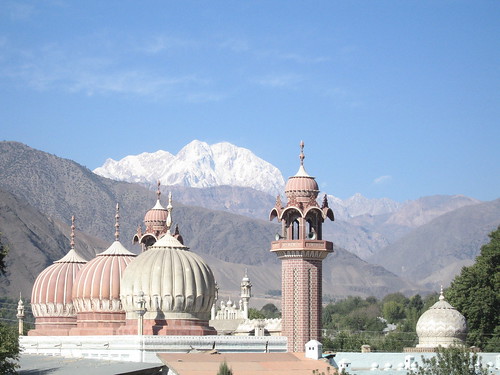
Shahi Masjid, Chitral, with Tirich Mir in the background (2)
Shahi Masjid, Chitral with mighty Tirich Mir in the background


After spending three days in the strange, fascinating and a world of its very own - the Fairyland of the Kalash Valley, the Mary Loosemore Hindu Kush adventure group moved to their next destination - Chitral, the land of the Tirich Mir. 

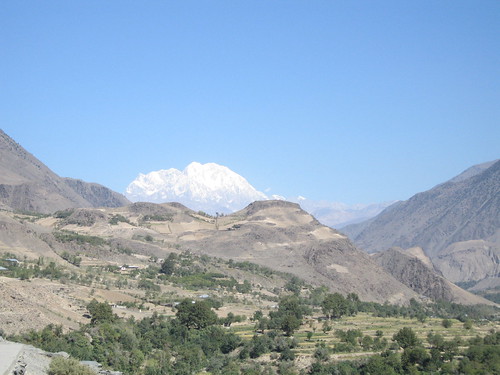
Tirich Mir is the highest feature of the Hindu Kush mountain range, located close to the Afghanistan-Pakistan border, which stands 7,708 metres tall and is visible from places as far as Ayun. Tirich Mir is also the highest mountain in the world outside of the Himalaya-Karakoram range. 
Map of Chitral [Google Earth map]


For their onward journey to Chitral and beyond, the Hindu Kush adventure group traced their route back east from the Rumbur Kalash Valley to the road Ayun-Chitral, and turning left and north for Chitral. The distance between Ayun to Chitral is 24 kilometres.
Tirich Mir, taken from the Rumbur road heading back to Ayun
Tirich Mir as seen from Rumbur Road while going back to Ayun for Chitral
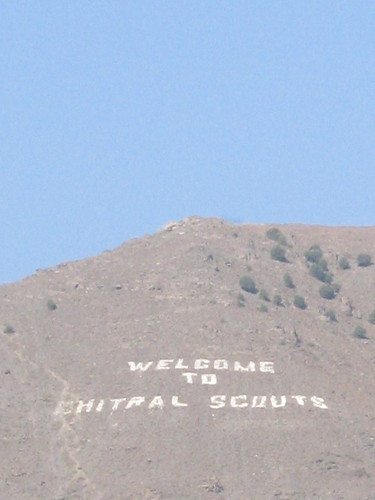
"Welcome to Chital Scouts" - just in case you didn't know you were in Chitral
Welcome sign by the Chitral Scouts - the para military force responsible for maintaining law and order in Chitral and policing the Pakistan - Afghanistan border

The group reached Chitral and was tucked in the Chitral Inn and hurriedly settled down for a quick refreshing cup of tea as seen below.
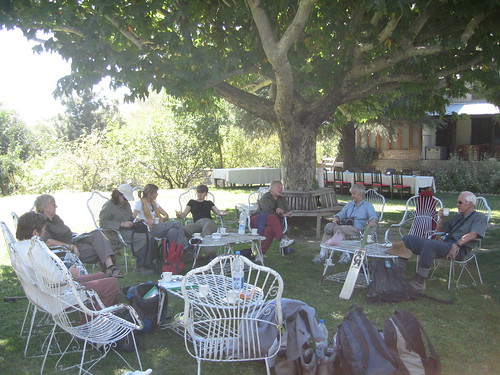
A nice cup of tea in the gardens at the Mountain Inn, Chitral
Joan, Ann, Ali, Annie, Amanda, Trisha, Thelma, Rob 


After the tea and wash up, the group, specially females headed to Chitral town to visit local landmarks shop the local specialties. 
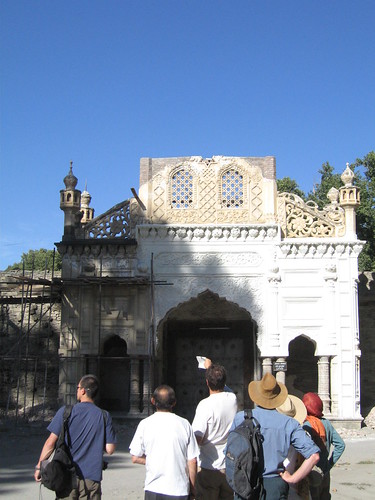
Gatehouse to Chital Fort and former Mehtar's Palace - badly damaged by the 2005 earthquake


The group watching the gateway to the Chitral Fort (above), which in fact is the former Mehtar's Palace. Chitral, was a princely state till 1969 when it was formally merged in the territories of Pakistan in 1970. Chitral was made a district of the Malakand Division and is presently the largest district of Khyber Pakhtunkwa province of Pakistan, spread over an area of  14, 850 square kilometres. The local language is the Khowar, or the Chitrali language, which is spoken in 13 different dialects. Beside Khowar, Pushto and Urdu are also spoken in the area. Till its merger, the state was headed by the chieftain known as the Mehtar. The fort was badly damaged during the 2005 massive earthquake that jolted the Northern areas of Pakistan. 
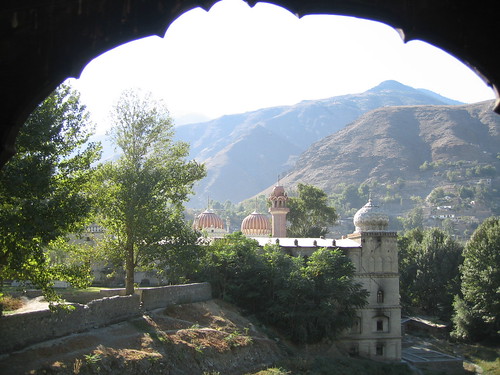
Framed view of Shahi Masjid, taken from the Water Tower, Chitral Fort
Shahi Masjid - as seen from the Water Tower of the Chitral Fort
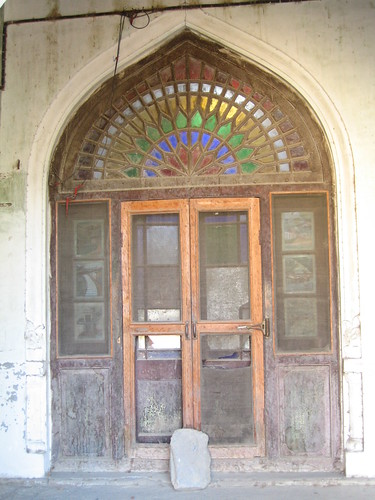
Ornate doorway in Chitral Fort
Ornate doorway in the Chitral Fort
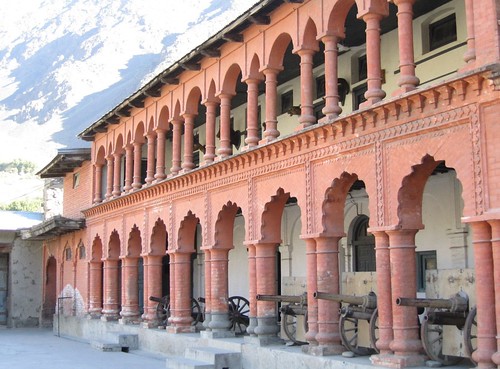
Chital Fort and former Mehtar's Palace, with canon
Chitral Fort - the guns of former Mehtar's army are now lined up in one of the corridors of the fort
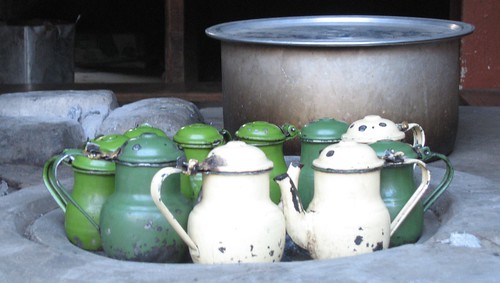
Chaikhana / tea stall
The day starts with tea - the Chitral way
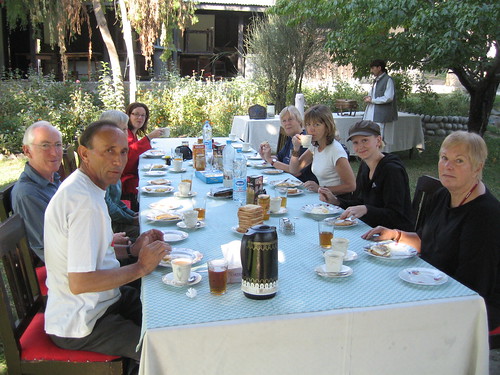
Breakfast at the Mountain Inn, Chitral
The first breakfast in Chitral: Zafar, Rob, Thelma, Ali, Ann, Annie, Amanda, Trisha


On the first day, the visit to Chitral Fort and the former Mehtar's was undertaken. The next morning dawned with the hearty breakfast, which looks like an English Breakfast of bread and eggs with milk-less tea, as seen above.
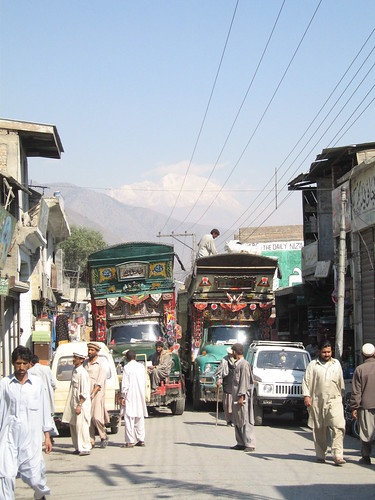
Traffic jam, Chitral town with Tirich Mir in the background
Chitral Town street - with Tirich Mir in the background
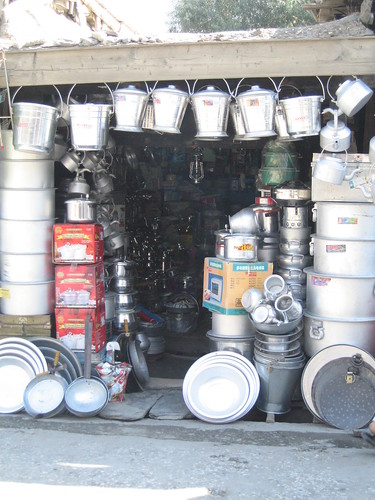
Hardware shop, Chitral
Kitchenware
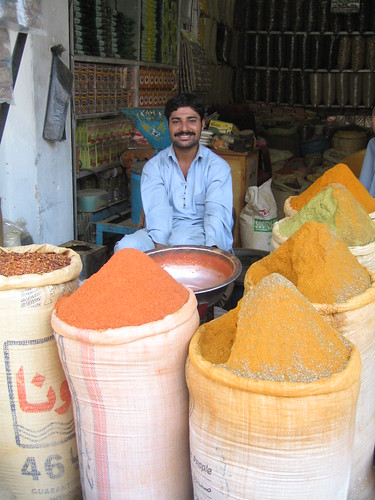
Spice seller, Chitral
Smiling spice seller posing
Chitrali hatmaker
Chitrali cap maker


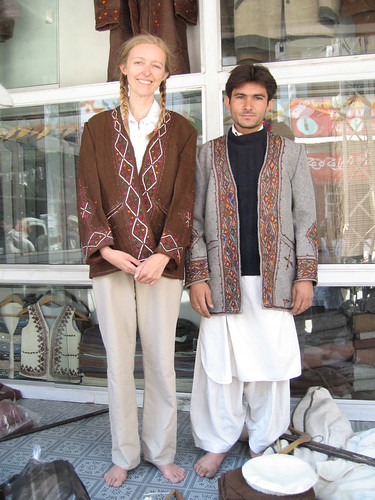
One of the specialty of Chitral is its traditional cap and gown made of pure lamb wool. Anyone visiting Chitral is tempted to buy at least one cap and gown for self, beside carrying these for friends and family. Besides, the  handicrafts, traditional jewelery, wooden works and dry fruit of Chitral are equally tempting specialties.
Iqrar Cap House and the tailor I bought my coat from, New Bazaar, Chitral
Mary at the Iqrar Cap House, buying a embroidered Chitrali coat for self
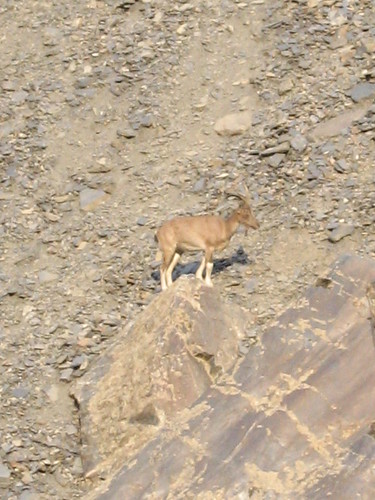
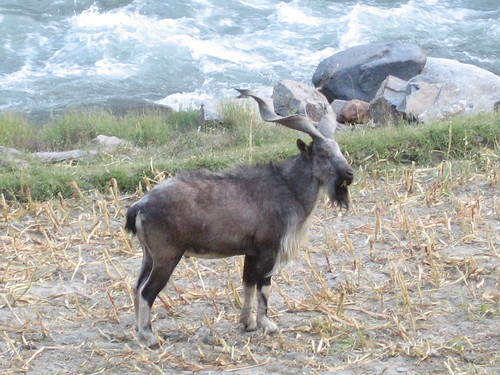
Markhor, Chitral Gol National Park (1)
Markhor  seen on the mountain slopes of the Chitral Gol National Park


The Markhor (Capra Falconeri Falconeri), which  mainly inhabits the sparsely wooded mountainous regions in Northern and Western Pakistan, at an elevation of 600-3,600 m, is  a rare and almost on the verge of extinct, due to excessive hunting by poachers. There are two main species of Markhor: the Kashmir Markhor, and the Astor Markhor.
Markhor, Chitral Gol National Park (2)
Close up of a Kashmir Markhor

The total world population is mainly found in Pakistan, and thus is the symbolic national animal of Pakistan. Efforts are at hand to conserve Markhor in the Chitral Gol National Park, which is at a two hours drive from Chitral. The park which is spread over three valleys is crisscrossed with numerous streams, abounds in tall cedar trees and several glaciers. The park is home to the extinct snow leopard, black bear,red fox, yellow throat ed martin, the Tibetan wolf, Siberian ibex, Himalayan otter and the Ladakh urial, beside the markhor goat.
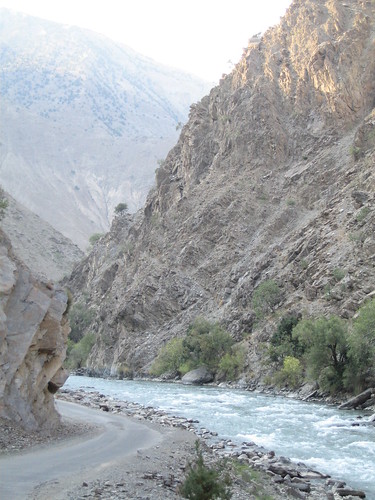
Chitral Gol National Park
Scenic view of Chitral Gol National Park
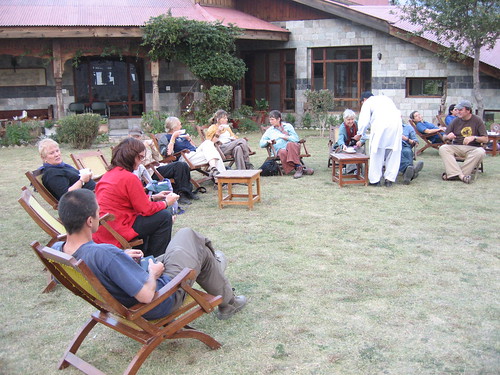
Tea on the lawn, Hindu Kush Heights, Chitral
Tea at Chitral: Benedict, Ali, Trisha, Amanda, Ann, Annie, Joan, Thelma, Rob, Stanley
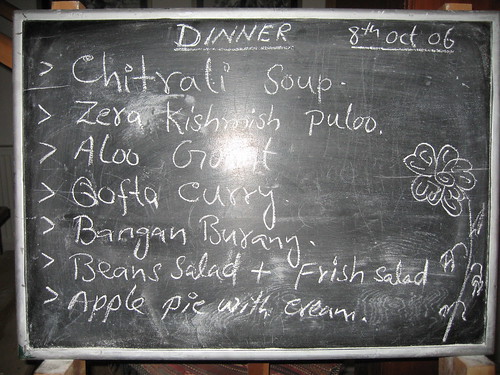
Menu for our dinner at the Hindu Kush Heights
Thew tempting dinner menu


The menu above gives details of the dinner: Chitrali Soup, Zera-Kismish Pulao (Cumin Seed-Raisin Pulao), allo Gosht (Curry of potatoes and meat), Gofta Curry (meatball curry), Bengan Burany (some dish of Eggplant ) - the last two are self explanatory.
Morning view of Chitral (and its landing strip) from the Hindu Kush Heights hotel
Morning view of Chitral from the hotel in Chitral

After Chitral, the group ventured north and north east towards Shandur Pass and onward to Gilgit, the capital of Gilgit-Baltistan. The journey onward is through spectacular scenery, awesome overlooking mountains and lakes with reflections of snow covered peaks. The journey onward will be covered in my next post.

Related:

All photos above, except where specifically mentioned, are the property of Mary Loosemore

Sunday, September 16, 2012

Lakshmi Chowk - The Heart of Lahore

Lahore has always been known as a warm, hospitable and entertaining city for centuries. Although, Lahore thrives and throbs in its every nook and corner, Lakshmi Chowk, situated on the cross roads of McLeod Road, Nisbat Road and Abbott Road, is one such place in Lahore which has not one but many facets that make it the heart of Lahore.
Lakshmi Chowk Map [Map: Google earth]
The place draws its name from the presence of the doubled storied Lakshmi Building [photo below], which is situated right on the cross roads as seen on the map above.


Lakshmi Building - watch its renovated look at the end of the post
I know Lakshmi Chowk very intimately, as for years I rode past the place in the double deckers of the Lahore Omnibus Service (LOS) during my school days. Since my house was located nearby on the McLeod Road, I also footed the place when going to watch a film as Abbott Road, an off shoot of McLeod Road from Lakshmi Chowk housed almost a dozen cinemas of Lahore.

Royal Park
In the early 20th century, when the films as entertaining media came to the then British India, Lahore became to be associated with the making of films as early as 1929 with the opening of the United Players' Studios on Ravi Road. And from then on, Lahore became an important film making centre with its many cinemas and film making studios, which were located in and around Lakshmi Chowk. Royal Park (pictured above and below) houses offices of major film distributors and producers of Lahore film industry.


Lakshmi Chowk has always been the focal point of Lahore’s film industry crowd. Even befoe the partition of British India in 1947, Lakshmi Chowk and Royal Park would throng with tongas and cars carrying film stars, film directors and producers in the evenings.

Indian superstars Pran, Muhammad Rafi, Om Parkash, Balraj Sani, Dev Anand and many less known artistes started their film careers from Lahore. Lakshmi Chowk was the hot spot for formal and informal film gatherings.All these actors later migrated to India in 1947.

Om Parkash who lived at Matti Chowk, Lohari Gate, always rented out a decorated tonga to Lakshmi Chowk every day. Pran lived in Qilla Gujjar Singh, half a kilometre away from Lakshmi Chowk. One day while standing at a pan shop in Lakshmi Chowk, he was picked up by Wali, a leading film director of the time, and offered him a role in his films. Wali wrote the address of Pancholi Studios (one of the most famous film studios of Lahore in Muslim Town) on the back of a cigarette pack, which brought Pran to the film industry.

There also was a hotel called King Circle at Lakshmi Chowk where film stars gathered. A bank has taken its place these days. 


I also have a long association with one once famous Aznic Studio, located just off the Lakshmi Chowk in the Royal Park on Abbott Road as seen in the photo above, which was our family photographer and many of our family portraits were shot by Aznic Studio. The Aznic Studio was the venue on 1 November 1967 when we five brothers accompanied by our parents had our group photograph on the eve of 25th wedding anniversary of our parent. This year if my parents were alive, they would have been celebrating their 75 wedding anniversary - but their life did not give them more time than what they had when they died in late 90s.

Rattan Cinema located just off the Lakshmi Chowk was once a thriving cinema of the area. Initially named Balwanti Rai Theater in the pre-partition days as seen below, the cinema screened some of the best films of the time. However, the almost demise of Lollywood has forced the closure of the cinema and now it awaits some buyer to convert into a commercial centre or to be used as stage shows.
Balwanti Rai Theater (Rattan Cinema) - 1940 [Photo: Project Lahore]

As I said before, almost a dozen cinemas were once located in the vicinity of the Lakshmi Chowk, mainly on the Abbott Road. I saw these cinemas mushrooming from my childhood. Some of the pre-partition cinemas included Rattan, Odeon, Nishat and one more (I have forgotten the name). Odeon cinema screened some of the best English films of the time, but later it started screening local films before being turned into a hotel.

Gulistan Cinema
The place where Gulistan cinema stands today housed a dilapidated building with lot of wild growth around it. In fact turning left from the intersection of Abbott and Montgomery Roads, it was a Dracula's place before Gulistan cinema ushered in a line of new cinemas. We five brothers when passing through the place would walk a little faster en route to watch a movie at Plaza cinema, lest Dracula came out of the haunted building and grab one of us.


However, this once busy road with many cinemas like the Metroploe, Mehfil and Mubarak is losing its charm. Mehfil and Mubarak cinemas have since long bid farewell to movies and have become venues for cheap stage shows.

Pre Partition Ishwar Das building, now known as Newage building, located on McLeod Road just short of Lakshmi Chowk
Besides film makers' offices and the cinema houses, Lakshmi Chowk is a hub of traditional eateries of Lahore. In front of ex-Odeon cinema, there is a line of eateries offering skewered chicken, Harisa, Murgh Chanay and Tuka Tuk. Many are of the view that the term 'Tuka Tuk' originated from these eateries of Lakshmi Chowk. 

Baghdadi Haleem
However, the best thing to eat here is the Shahi Murgh Chanay (a heavily oiled and spiced curry of chick peas and chicken), which one can only enjoy if eaten fresh at the eatery with oven fresh bread. Whenever I go to Lahore, I try my best to visit the place at least once to eat Shahi Murgh Chanay. As for Baghdadi Haleem, pictured above, I wonder if the people of Baghdad ate Haleem - but this eatery surely attracts crowds interested in Haleem.
Beside traditional eateries, air conditioned restaurants like Lasani (above)and Tabaq(below) provide a pleasing sitting environment even in scorching heat of Lahore. Tabaq was the first eatery of Lahore that came up with the idea of broast chicken in special broast machines. From then on, the name Tabaq has become synonymous with broast chicken all over.
Dry fruits seller at Abbott Road
 Renovated Lakshmi Building as of today Photo: One Pakistan
Lakshmi Chowk houses old buildings dating pre-partion days and needed to be preserved in their original form. However, lately there has been an effort to 'renovate' and face uplift these buildings, as seen above, with gaudy colours and with complete disregard to the age of these building. The so called uplift seems completely out of place and the facade of buildings, specially that of the Lakshmi and Newage buildings has become an eye sour rather than the once elegance these buildings had.

There has also been attempts to demolish these buildings by their owners and erect new plazas. It was after strong public reaction that such attempts were blocked for buildings which have been placed under the conservation rules to preserve the historical heritage of Lahore.
Another landmark just off the Lakshmi Chowk on Nisbat Road is the famous Dyal Singh College (above) and Dyal Singh Library (below). The college and library were established as two separate trusts in 1898 according to Sardar Dyal Singh Majitha's will, who was a great humanitarian and lover of education and donated all his assets for the propagation of education.

Although, even today Lakshmi Chowk is a major centre of Lahore film industry, it is losing its glamour with the almost demise of the Lollywood. Now a few offices of film producers and distributors remain and it is seldom that actors and actresses visit the area to meet producers and directors. However, sometimes they are seen eating at some eatery around Lakshmi Chowk.

Photos Attribution: All photos above, except where explicitly attributed, are the property of Tahir Iqbal. Tahir is an avid photographer with keen eye to capture the street scenes and life of ordinary people. I have already shared his photos in a number of posts earlier posted at Jaho Jalal.

Related: 
Google Earth 
Posts composed of Tahir's Photos:
If you like Jaho Jalal, please follow us on Facebook

Saturday, September 8, 2012

Mary Loosemore's Photo Travelogue: The Fairyland of Kafir Kalash

In my previous post based on the photo travelogue of Mary Loosemore, I covered the journey of the 11-member Hindu Kush adventure group, that also included Mary Loosemore, from Peshawar, Pakistan to Dir and Ayun through the Lowari Pass. Today I will cover the group's adventure, as photographed by Mary, into the fascinating world of the Kalash Fairyland - the Kalash Valley.


A Kalash woman dressed in traditional black robe ornamented with multicoloured beads and headdress

Kalash Valley consists of three sub valleys as shown in the map below. The Mary Loosemore's group selected the Rumbur Valley to explore the hidden world of the Kalash people. On 4 October 2006, they reached Balanguru for a night stay with the Kalasha.


From south of Chitral, a track turns to the left from village of Ayun on Kunar river to the Kalash Valley, where these strange yet attractive people live in three main villages and surrounding areas of Rukmu, Mumret and Biriu (called Rambur, Bumburet and Birir in local Kalasha language).

Map showing the route to three Kalash Valleys from Ayun

Bumburet is the largest and the most picturesque valley of the Kafirs, is 40 kilometres from Chitral and is connected by a jeepable road. Birir and Rambur are located at a distance of 34 and 32 kilometres respectively from Chitral. The present population of the Kafir Kalash is approximately 6,000. 

Road to Rumbur Valley - Photo: verdanega / Panoramio

The villages are situated on the southern face of the hillside about 50-100 meters above the river. This protects them from floods in summer, and at the same time helps to get sunshine during the winter. The snow that lies on the bottom of the ravine and in the shade do not melt until spring. 


A typical Kalasha village on the mountain terraces in the Rumbur Valley


In summer to avoid the sun, some people live in a second house built on the opposite side of the river. The Kalash Valleys have extensive forests of Holly-Oak and Himalayan cedar. Walnut, Apricot, Apple, Pear and Mulberry trees abound near the villages.


Pakistan flag flutters near a house in the Balanguru village - Rumbur Kalash Valley

An almost three days stay in the Rumbur Valley, moving from one village to another, provided Mar's group a deep insight to the life, culture, traditions and lifestyle of the Kalash people. Following are the photos taken in the Balanguru village of the Rumbur valley.


A Kakasha child with shinning green eyes - typical of Kalash
 

 A Kalash women laughs as 'strange men' crack jokes
 Benedict, one of the group member, shows photographs taken of the Kalash children on his camera
 Lunch at Saifiullah Jan's new house, the local host at Balanguru village
 Kalash children en route to their school
 A walk through Balanguru village
  Kalash girls en route to their school 
 Mary had her hair plaited the Kalasha style by small Kalash girl
 A Kalasha family
 Kalash girl hand weaving for tying the hair
 Style girl at Balanguru
 Kalasha girls group photo

Those who visit the Kalash Valley in early summers, they can attend Kalash festivals held in the early summers. The two main important festivals are Joshi and Utchal. In the late summers and winters, two more festivals Phool (20th-25th September) and Chowas (18th to 21st December) can be attended, though the latter is very difficult to attend owing to losure of the Lowari Pass. However, if one can make it to Chitral by air, then from Chitral to Kalash Valley by local jeeps is possible.


Joshi or Chilimjusht: This festival is held from 14th to 15th May to mark spring when girls pick the first flowers of the season. Traditional dancing, visiting each other, exchanging flowers, milk and milk products are its features. 

Utchal: This colorful event is celebrated in mid-July to mark the harvest of wheat and barley. The two- day celebrations feature dances, singing and hosting feasts.


 Pre-dinner cricket match: Hindu Kush XI vs Kalash XI!! [above/below]

Dinner being prepared at Balanguru village rest house
A hearty dinner and smiles
Balanguru village as seen from Safiullah Jan's guest house

After Balanguru, the group visited the village of Shakanande. The following photographs were taken during their visit to Shakanande:

Mary Loosemore at the top of the tree line, passing over the coll between Shakanande valley and the Rumbur valley
 Shakanande Village, Rumbur Valley
 Mary crossing a stream in the Shakanande village
A boy entering the house through a carved door - specialty of the area

The last village the group visited was that of Palaga. Here in under are some of the photos taken at Palaga Kalash village:

 Daughter of the host
 Annie and Amanda during a hike near Palaga village - eating locally grown grapes
 Dinner being prepared at Palaga
  Mary, Annie and Amanda - Dinner is over
 The group en mass at camp fire night [ Saifullah, Mary, Annie, Amanda, Rob, Annie, Benedict, Thelma ]
 Hikers resting for a quick snap
 View from the Palaga rest house
Relaxing at charpoys - native beds with four legs at Palaga
 Kalash family 

Grandmother with her niece

After a three days long stay in the Kalash Valley, the Hindu Kush adventure group moved to Chitral for a day's stop, before resuming their journey onward in the Hindu Kush range to Gilgit, through the Shandur Pass. My next posts will cover the stop over to Chitral and travel to Gilgit.

Read more about Kalash and their festivals:
Kalash Spring Festivals (Pakistanpaedia)

All photos above, except where specifically mentioned, are owned by Mary Loosemore, as shared on Flickr.