Showing posts with label Festivals. Show all posts

Sunday, December 16, 2012

Chitrimas: Another Type of Christmas for the Kalasha

Every year when the world is still gearing up to celebrate Christmas, a unique and different winter festival almost synonymous to Christmas has already started in the three remote villages of Chitral in the northern Pakistan.


Chitrimas or Chamois is the winter festival of Kalash people living in the three villages of Rumbur, Bunboret and Birir. As you may already know Kalash are a unique people with no parallel found anywhere in the world except neighbouring Afghanistan. The festival is celebrated for two weeks from 9-22 December. However three special days are announced each year, 15-17 December this year, for the height of the festivities.

The Kalash people or the Kalasha live in unique houses made of local stone and wood which are stacked on top of one another against the hills so the roof of the lower house is the veranda of the upper. They make their living with staple crops like lentils and wheat and goat herding. Life is very traditional and, like in many in this part of the world, the division between men and their women is great. Family life, cattle herding and harvesting form their main livelihood with the occasional distraction of a festival or two. Women move into a Bashleni house during birthing and also when they are menstruating. Many aspects of the society are both communal and segregated and, typically, marriages are by arrangement.


Their festivals ae also unique spread over different times of the year which are celebrated wearing colourful beads over black embroidered gowns by the women folk. One of the most important festivals celebrated by the Kalasha is the Chitrimas or Chamois welcome the new year. 

The Chamois festival is celebrated without using any musical instruments in the Rumbur and Bumborate villages, whereas residents of Birir village do use the musical instruments. Chamois festival is celebrated after the Kalash finish all their fieldwork and store all the sources of their basic needs. By this time of the year cheese, fruit and vegetables and grains are properly stored. 

By this time, it is time for the Kalasha new year to set in. In fact, With the celebration of the festival, the Kalash month of “chawmos mastruk” sets in. Chamois is also called “ghona chawmos yat” which means, the great memorial Chamois festival.

The festival is considered to be a very sacred festival. After all it is the start of the New Year. It is the last festival of the year. It is the time when the entire family sacrifice and eat meat, it is celebrated by feasting, drinking of wine and merry making. In fact the Kalasha bey celebrating this festival thank their gods for the bounties bestowed on them during the year and pray for the same during the coming new year.

Before the proceedings of the festival start, the entire population remains indoor. It is celebrated by feasting and merry making until the elders, who sit on a hill top, watching the sun reaching the orbit, declare the advent of the New Year. Children go up to the mountain, where they divide into boys and girls, and respectively make a big bonfire. After singing songs for some time the fire will be extinguished and then the two groups will compete with each other for the size of the smoke that rises up in the air. Then they all go down the mountain and return to the village singing " songs of Sarazari" carrying branches cut down from the mountain top. The elders will be waiting chanting songs in the village.

Read more:
Kalash Festivals [PTDC]

If you like Jaho Jalal, please follow us on Facebook

Monday, July 23, 2012

Scenic Maho Dand Lake attracts tourists this summer in Kalam Valley, Swat

Swat, once tourists haven, which had under the grip of militants awhile ago, has lost its galore and a tourist attraction as no one wanted to be entrapped in a militancy hit area. 

However, thanks to the efforts of the Pakistan Army, which with the assistance of the locals, not only defeated the militants and cleared the area of these armed miscreants, but has also brought back the once hustle and bustle of tourists which it was famous for centuries. Now the business which had almost reached a dead end is started to flourish again as tourists are thronging Swat to beat the heat off as temperatures are rising in the plains.

Recently, a tourist festival was held at the scenic Maho Dand [dand in local language means a lake], located some 35 kilometers from Kalam. Mahodand Lake can be best described as an artistic endowment of nature, where the unspoiled natural beauty mingles with serenity and calmness. The festival was arranged by the local Pakistan Army commander with the assistance of the civil administration and tourism department.


Watch the video below and see tourists enjoying at the Maho Dand in the Kalam Valley of Swat:


The holding of such festivals is likely to bring back the life to Swat, where life and livelihood of locals entirely hinges on the tourists. Do visit Swat, specially Maho Dand lake, you will be spellbound and cherish its memories forever.

Video Published on Jul 21, 2012 at YouTube - shared with Courtesy 

Friday, July 20, 2012

Spanish Festival of San Fermin - Festival of People and the Bulls


Spaniards are perhaps the most liveliest people around the world. The enjoy and celebrate festivals, even at the cost of hurting them - and hurting pretty badly.


Every July, the Spaniards celebrate the festival of San Fermin in the ancient city of Pamplona. While almost the entire city goes out in the street, there are bulls following. In fact the festival is about people and the untamed bulls. 

The festival of people and the bulls was first held in 1591 starting 7th of July. Initially the festival was for 2-3 days, later it was extended to July 10th and then to July the 4th - that means a clear seven days of excitement, cries, joy and wounds - sometimes very fatal too.


During the festival, the streets and cramped alleys are full of people of all ages and gender - making merry, shouting, running and enjoying. Normally they are clad in reds and it looks as if a red wave is flowing in each street and alley.

Watch a few glimpses of the festival below:


The daring ones run in the streets, while the less daring and old watch the festivities from their balconies with Spanish flags decorating the buildings.


If you are in the streets, be cautioned that you will be pushed in the cramped and crowed streets, really gasping for air. So dare if you can.


You may be lucky to see Muhammad Ali, the greatest, in the streets watching exhausted or knocked over fun lovers. Some even dare to take their small children in the deadly streets - and they too are seem to be enjoying the fun laded festival.


Bull-running became part of the festival in 17th and 18th century chronicles together with the presence of foreigners. In fact it is the bull-running that adds 'spice' to the festival.


Every afternoon between the 7th and 14th there is a bullfight in which the 6 bulls that have been driven to the bullring during the bullrunning of that day are killed. It begins at 18:30.


Every night a firework spectacle is held at the citadel park. Fireworks spectacles have been known to occur in Sanfermin as far back as 1595. Since the year 2000 an international fireworks contest is held. Thousands of people watch them seated on the grass around the citadel.


The aftermath of the festival is bruises, injuries and lots of litter on the streets. But despite the hazards and dangers, the festival of people and the bulls continues for centuries and people go home laughing and enjoying every day after the bulrunning is over. 

If you happen to be visiting Spain in the month of July, do attend the festivities of San Fermin in the ancient city of Pamplona - you will cherish the memories for as long as you live.

Photos Source: Funzug

Thursday, June 14, 2012

Hot Air Balloon Over Lahore

I have been collecting stamps since long, but recently I came across a unique FDC that I was not at all aware of . The FDC shared on Face Book by Lahore - City of Gardens is a unique 2 Paisa valued stamp with stamp mark of  issued on the eve of National Horse and Cattle Show held in Lahore from 4-9 March 1964. 

FDC First Flight Balloon, Lahore / National Horse and Cattle Show, Lahore 4-9 March 1964 [FDC Courtesy:  Project Lahore]
The FDC on its left has a drawing of Badshahi Mosque of Lahore with a hot air balloon flying over the mosque domes. There are three stamps on the FDC:

1) On board of Freeballoon Oxygenium - Pilot: Nini Boseman
2) National Horse and Cattle Show - Lahore 4-9 Mar.1964
3) First Flight by Balloon, Lahore 8-3-64.


The FDC takes me back to 1964, when I attended this particular Horse and Cattle Show too and saw the Tattoo Show performed by the troops of Pakistan Army. A few days later on 23 March 1964, I was again at Lahore Fortress Stadium to witness the Pakistan Day Parade, which used to be a regular feature of those day and continued till as late as 2000s, where I for the first time in my life had seen F-104 Starfigher roaring over our heads as a special appearance for the Lahoreites and perhaps its first public appearance since their accquisition from the USA through Jordan. I shared my memories about the display in a separate post at Jaho Jalal awhile ago.

Originally posted at: My Philatelic World

Monday, March 19, 2012

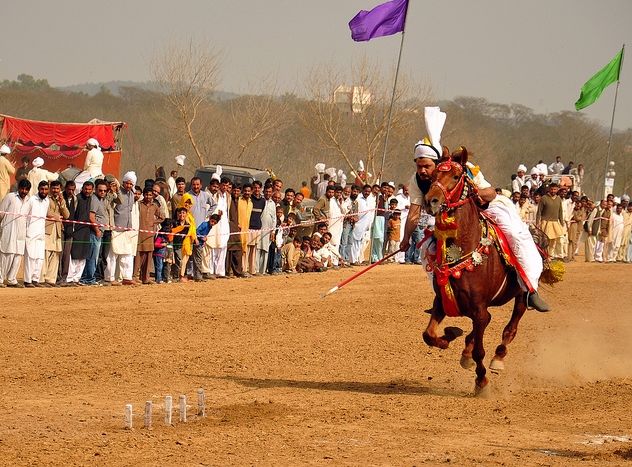
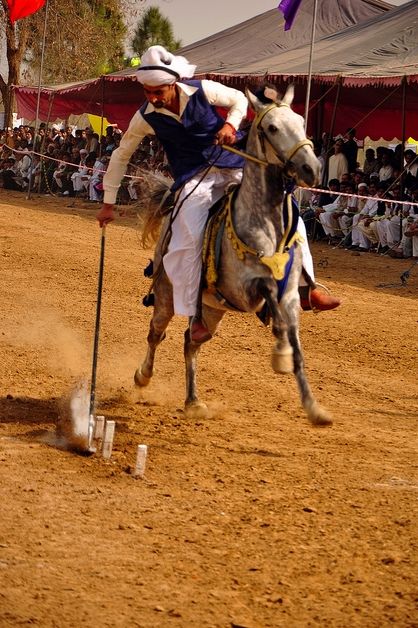
Tent Pegging - a sport of Majestic Horses and Horsemen

Horses since life started have been the best companion of men. The have charged into the ravage battlefields carrying warriors, horsemen and the cavilers, fighting and falling with them. And in peacetime, they trained hard with their masters to prepare for the rigors of battles, besides providing horsemen opportunities to sport and hunt.

One of the favourite sport for the horsemen is tent pegging - something which prepares the warriors and the cavilers to train for accurate targetting in wars. The history of sport of tent pegging has been traced back to at least the 4th century BC.It is not clear what specific purpose the tent pegging accrued, but as the name suggests, the cavilers used this technique in their surprise attacks on the enemy camps, and taking out the pegs of their tents, thus creating alarm and chaos and subduing the still half asleep enemy soldiers. In George McDonald Fraser's Flashman novels, title character Harry Flashman served in a lancer regiment, and frequently mentions tent pegging and his broader skills with the lance.

Now that warriors no more ride into battles on majestic horses, these still carry horsemen into the playgrounds to keep alive the tradition of horsemen and horsemanship. The relationship between man and horse is not to cease.

Tent Pegging is played in may countries of the world, including Pakistan. Every year, during the harvest seasons' festivities, horsemen clad in white suits, varying colours of waist coats and long turbans ride their majestic horses and charge into the battlefield of tent pegging at speeds one cannot imagine. The horsemen align themselves with the lances as the near the pegs pitched into the ground, and almost all hit the bull and take out the peg and march of with pride and jubilation.

During the Jashn-e-Baharan, the Spring Festival, the tent pegging is a must event - wherein horsemen, usually farmers, after a sucessful harvesting, show their feat of fine horsemanship and tent pegging. The sport of tent pegging is mostly played in the Punjab province, and teams from Lahore, Gujranwala, Faisalabad, Rawalpindi and Atoock are famous for the mastery in the sport of tent pegging. Once the famous Horse and Cattle Show held at Fortress Stadium Lahore was one such grand festival where besides many feats by the military police motorcyclists and bands, tent pegging was a regular feature. Now this festival is also part of many other cities during the annual Cattle Market or Mela Maweshian.

Herein under are some of the finest photos of tent pegging, shot and composed by my Flickr friend Asif Saeed, whose other bautiful photos I have shared in my earlier posts. I have tried to put the photos in a chronlogical sequence so as the keep the readers interest alive in this rather long post.

And do not forget to watch a video on tent pegging at the end of the post, Ishared from YouTube.
Tent Pegging teams clad in colourful dresses and large turbans, mounted on fines horses march into the arena
Before the show begins, there is show march of the tent pegging teams
  
Like the horsemen, the horses too are colourfully decorated with buntings 
The teams line up for the charge in

A tent pegger aligns himself with the pegs, pegged in the ground

Closing on to the peg

Bull Hit: The lance is clearly seen pierced in to the peg - a beautiful shot by Asif Saeed

A proud winner
-->

Now watch a video below I have shared from the YouTube. The video shows the tent pegging team of Lahore Polo Club, shared by Husnain67. Just watch how majestically each player charges into the ground on his beautiful pony, aligning and taking out the peg with grace and joy:


About the photographer: Asif Saeed is a young and enterprising photographer, who takes time out of his professional obligations and travels widely. He has been to every place in Pakistan and has visited many countries. Wherever he goes, he has his camera by his side and even when tired of climbing mountains, he manages to shoot some of the awe inspiring photos.

Update with the following video on 25 October 2015:
Today I came across a video shared at Facebook which shows a unique display of tent pegging at night - something I have never seen before. I am sharing this video here to make my post on tent pegging wholesome and complete for the interest of my readers. 

Watch the video below:


Night Tent pegging a beautiful game in National Horse and Culture Show 2015,Lahore
Posted by City District Government, Lahore 

I have earlier on shared his photos in following posts:

Sunday, March 18, 2012

Plan a visit this September to Netherlands for Fruitcorso Festival

Fruitcorso Festival in Netherlands
Fruitcorso Festival, Netherlands - a Festival of Fruits
Tourists and travelers are the luckiest people around the world. These are lucky because they get to see the indigenous life and festivities of the people they are visiting. And if one plans one's visit to a country when it is time for the local festivities, one comes back with life long memories and lots of photographs that remind one of the wonderful times spent abroad.

With the availability of handy digital cameras or even the cameras inbuilt in the cellular phones, the travelers have an endless storage place to store photos of the beautiful moments, people, their lives and celebrations of festivals that they can cherish for as long as they live.

And talking of the festivals, what beautiful place on earth can be other than the Netherlands - a country known for his beautiful flowers that bloom everywhere you go. But besides flowers, the country abounds in countless varieties of fruits that are harvested and grown all over the Netherlands.

One of the many festivals that are held in the Netherlands, one of the festival is known as the Fruitcorso Festival. The Fruitcorso Festival  is celebrated in September each year to celebrate the harvest of fruits of all the villages in Tiel, Netherlands. The festival includes a parade of cars beautifully decorated with fruits of all types.

Just scroll down slowly and see the collection of photos of the Fruitcorso Festival and do admire the aesthetic sense of the people of the village of Tiel - it is something that I would very much want to visit next time I am travelling abroad. This festival is a tribute to the people of Tiel, who not only harvested fruits, but also enjoyed their harvest to thank the Nature for the countless gifts bestowed on to them which not only fetch them money but also attract tourists from all over the world to join them in their happiness, joy and festive mood.

Fruitcorso Festival in Netherlands

Fruitcorso Festival in Netherlands

Fruitcorso Festival in Netherlands

Fruitcorso Festival in Netherlands

Fruitcorso Festival in Netherlands

Fruitcorso Festival in Netherlands

Fruitcorso Festival in Netherlands

Fruitcorso Festival in Netherlands

Fruitcorso Festival in Netherlands

Fruitcorso Festival in Netherlands

Fruitcorso Festival in Netherlands

Fruitcorso Festival in Netherlands

Fruitcorso Festival in Netherlands

Fruitcorso Festival in Netherlands

Fruitcorso Festival in Netherlands

Fruitcorso Festival in Netherlands

Fruitcorso Festival in Netherlands

Fruitcorso Festival in Netherlands

Fruitcorso Festival in Netherlands

Fruitcorso Festival in Netherlands

Fruitcorso Festival in Netherlands

Fruitcorso Festival in Netherlands

Fruitcorso Festival in Netherlands


Fruitcorso Festival in Netherlands

Fruitcorso Festival in Netherlands

Fruitcorso Festival in Netherlands

Fruitcorso Festival in Netherlands

Fruitcorso Festival in Netherlands

Fruitcorso Festival in Netherlands

Fruitcorso Festival in Netherlands

Fruitcorso Festival in Netherlands

Fruitcorso Festival in Netherlands
Photos Source: Funzug