Pakistan is one of the gifted countries of the world which takes you from the beeches of the Arabian Sea in the south to the snow clad towering mountains in the north through deserts and lush green plains. Each place has a charm of its own with different people of varying culture and language - but equally hospitable and extremely friendly, always extending a hand to let you feel at home. There is much to see and eat in Pakistan. From the roadside vendors and eateries that sell indigenous, spicy and mouth watering locals delicacies to starred hotels where one can eat the same dishes in cozy air conditioned environment served by waiters clad in starched uniforms and wearing that friendly smile one comes across everywhere in Pakistan. But the joy of eating amid the indigenous people in the roadside eateries has its own charm which cannot be described in words but to be felt personally. And one can never forget children in streets running to greet a forefinger and insisting a snap with them.
Pakistan can be reached through international airlines that connect cities of Karachi, Lahore, Islamabad, Peshawar and Quetta or else one can enter by road from either India, Iran, Afghanistan or even China. Each land route entry has its own charm for these let you enter Pakistan and giving you a opportunity to straightaway get into touch with locals of different provinces of Pakistan shaking hands with traditional warmth and welcome. We have started this series of posts to share experiences of foreign tourists who are amazed to find a Pakistan much different to one's perception. In fact the media around the world which once projected Pakistan as a Taliban country with people skirting by with guns in their hands, has now started to realize that Pakistan is far different from what has once been projected. In fact those who come to Pakistan go back with very pleasant memories that they cherish for a long time besides sharing these with their friends which compels them to include Pakistan as their top travel destinations in their travel plans. In this post, we are sharing experiences of Karl Rock who crossed over to Pakistan from India through the famous Wagha Border at the outskirts of Lahore. And here devours on beef haleem, one of the delicious dishes of Pakistan. Watch the video below and be amused by his experiences and MAJOR FALLS!!
I hope you enjoyed this beginner - stay tuned for many more such surprising experiences from tourists around the world.
Once upon a time stories have always been fascinating as these always talked about beautiful princesses and princes, sometimes princes turning frogs too though. But their end was always charming and ending with kisses and love forever.
I too grew up listening th the once upon a time stories and I wish I could go back to my childhood when may parents and all siblings were there under one roof and listen to those fascinating stories once again. But now with parents long gone and all siblings living their own lives scattered over different places, once upon a time is only a dream now. And let me share my Once upon a time In Lahore [1], where I was born, raised (listening to the stories), and then left in search of my bread and butter to places far away never returning to live there again. But whenever I visit Lahore, I make sure I walk down on lanes and streets where I once walked with my family - now I walk alone cherishing the nostalgia of the days when love was in abundance and everywhere.
One of the roads we frequented with my family after sunsets was the Abbott Road. Starting from our house near once famous and thriving Lahore Hotel, we would go to Abbott Road truing left from where now Gulistan cinema stands. In those days, there was abandoned house surrounded with bushes and trees and looked like Dracula's house. In those Dracula films were very famous, or notorious I may say, and whenever we five brothers went past that place, my pace would speed up lest Dracula got out and suck my blood. But with my family and parents around, I felt no fear for my father was a fearless man and I know he would break Dracula's neck if he dared !!! OK back to the Abbott Road, which like the abandoned "Dracula's house, was all barren, unlike its present screaming and congested traffic due to many cinemas that came up, was quite road with fields astride both side of the road. At the end of the road, there stood the Radio Pakistan building, the Television Station came a few years later in 1964. From here we would turn right to climb the once famous Shimla Pahadi (Shimla Hill). I do not know why it was called after Shimla, a beautiful tourist resort of northern India, but perhaps the presence of this raised ground reminded someone of Shimla and this small hillock was so named. It was here that there used to be lot of fireflies and they would give their feint yet visible light and fly by us. My mother would catch some of these in her dopatta and I would cry with joy seeing these fiery creatures trapped inside. And could cry when my mother would let them go. Now there is no Shimla Pahadi and no fireflies, and no once upon a time stories. All gone with the wind of the time and leaving behind the memories which saddens me for it reminds me of my parents and my elder brother who are no more, may they be blessed, and the galaxy of siblings living in their won smaller worlds, perhaps reading out once upon a time stories to their grandchildren. Do you remember your once upon a time stories?
Photo : [1] Lahore is a thriving city in the Punjab Province of Pakistan If you like Jaho Jalal, please follow us on Facebook Follow @JalalsPages
23 March is an important national day in the life of Pakistan - It is the day when on 23 March 1940 the Pakistan Resolution was unanimously put forward in a historic meeting of the All India Muslim League during its annual meeting at Lahore's Manto Park (later renamed as Iqbal Park after Dr. Muhammad Iqbal, who for the first time gave the idea of a separate Muslim state to be carved out of the British India as he could see that Muslims and Hindus could coexist - something that has now abundantly seen in the present day India where Hindu hardliners are deadly against Muslims and torture them in one way or the other) to demand for a separate homeland for the Muslims of the British India. It is also the day when the first constitution of Pakistan was adopted. The relevant part of the resolution is as under:
No constitutional plan would be workable or acceptable to the Muslims unless geographical contiguous units are demarcated into regions which should be so constituted with such territorial readjustments as may be necessary. That the areas in which the Muslims are numerically in majority as in the North-Western and Eastern zones of India should be grouped to constitute independent states in which the constituent units shall be autonomous and sovereign.
It is also the day in 1956 when Pakistan was declared Islamic Republic of Pakistan from the Dominion of Pakistan and broke away the remnants of the British yoke which it continued even after partition from the British India on 14 August 1947. Initially the day was called the Republic Day but later integrating the two milestone events of same day in 1940 and 1956, it started to be known as Pakistan Day.
To commemorate this memorable day with honour and dignity, a Pakistan Day parade by the armed forces of Pakistan is held.
For me, this day has a tinge of nostalgia as it was this day in 1964 when I witnessed the armed forces parade for the first time at Fortress Stadium Lahore. And the hallmark of the day was the fly past of the supersonic Lockheed F-104 jets, known as the Starfighter - the first supersonic aircraft of Pakistan, which had then been recently acquired from USA through Jordan. In fact at that time, Pakistan was the only country outside NATO which had been supplied with this modern aircraft of its time. The whole crowd of spectators applauded with a thunderous clap when the Starfighters flew past over our heads. Later it was the same aircraft, which broke the sound barrier around 11 AM on 6 September 1965 - a thunderous noise that announced the breaking out of war between India and Pakistan. I was in school when the sound barrier was broken and it was soon after that our school was closed and we were all sent home.
That was 1964 - but as the 23 March 2018 dawns in Pakistan, the Pakistan Air Force proudly flies its indigenously produced JF-17 Thunder lightweight, single-engine, multi-role combat aircraft, which has been developed as a joint venture by Pakistan and China, and inducted in Pakistan Air Force in 2010. So far about 100 of block I and II versions of JF-17 Thunder have entered in active service of the Pakistan Air Force.
And plans are afoot to work on the block-III with many advancements in avionics, ordnance carrying capability and cruising range. Powered by a Guizhou WS-13 or Klimov RD-93 after burning turbofan, it has a top speed of Mach 1.6 and is equipped with air-to-air and air-to-surface missiles, and a 23 mm GSh-23-2 twin-barrel auto-cannon.
And that is not all - in the meantime Pakistan Army and Navy too have undergone substantial changes and news weapons and platforms have been added. Thus today's parade shows up a huge weapon show in the parade ground outside Islamabad with lush green Margalla hills in the back ground.
This portion of the post is added on 23 March 2022:
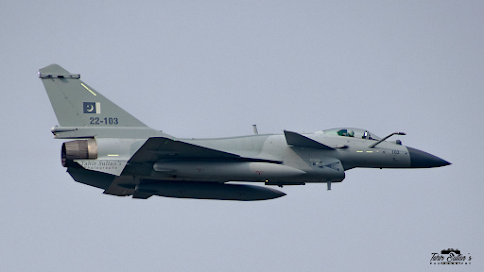
Pakistan Air Force has come a long way from F-86 Sabers to F-104s and then the second stage of induction of state of the art F-16s in early 1980s. Now in the 2000s, we have Joint Fighter 17s Thunders and very recently inducted J10Cs from China. We always have had the game changers.
We shall write mor about J10C shortly. The present inventory of Pakistan Air Force is formidable and we intend building it on with possible induction of Chinese J20s, the stealth 5th generation aircraft in times to come. The entire nation stand behind its gallant armed forces which are not only the single largest contributor the UN Peace Keeping Missions across the world, but is also one of the longest embattled army with the terrorists and miscreants mostly coming from Afghanistan, targeting and falling back. The effective check and ruthless elimination of terrorists' havens has afforded much needed peace to Pakistan to concentrate on its developenmtal plans for present and future. Though it is sad to see USA and other world powers still not acknowledging sacrifices of some 70,000 and still press on Pakistan to do more. Our Armed Forces would continue to fight back terrorism in any form and one day God willing will be successful in its efforts. Read my previous post on F-104s: 23 March and the F-104 Starfighters
Mail Online is one of my favourite reading sites on Internet and I share many news and posts in my blogs. Today while going through some of the older posts, I stopped in my tracks about a post Katie Amey who wrote about the travel adventure of a lone 29 years old Georgian photographer who chose to visit Pakistan despite caution and apprehensions of her family and friends. The story is about Teo Jioshvili, from Tbilisi in Georgia, who travelled to the perilous country of Pakistan ALONE in 2014 and visited the historic city of Lahore - often labeled as the showcase of Mogul architecture.
Children in particular fascinated Jioshvili - such as this street girl
Children going to school
The intrepid traveller, who aspires to be a travel photographer, first got the idea to visit after a trip to Iran. 'When I was in Iran, I met amazing people from Australia who crossed Pakistan - and one of my Georgian traveller friends had also travelled there,' she tells Mail Online Travel. 'Their stories inspired me.'
A street painter
Her travel experience are both interesting and much revealing about the hospitality and warmth of the people of Lahore and of a country where travellers are cautioned not to visit by their governments. Although the country is plagued by the menace of terrorism, it does not mean that Taliban or the terrorists roam in the cities of Pakistan with weapons slung on their shoulder and killing every foreigner in sight. Perhaps it was for this misconception that Miss Jioshvili was warned of her Pakistan adventure. But she has fond memories of her visit to Pakistan.
'I was often stopped on the streets and in Bazaars someone would ask me to take a picture of him or her with me,' she says. If ever any men asked to take a photo with her, they were always extremely respectful. Infact if there was another male (another traveler or guide) with me, they would ask him for the permission to take a photo with me. I think that was a really beautiful sign of appreciation.' Most of the time, people would just give me an apple or an orange. That was just very sweet.'
Jioshvili aith a group of young Pakistanis
She was taken to a wedding party on her very first night in Lahore by a German tourist staying in her hotel. The wedding was 'wedding party was just an incredible experience with its music, traditions, smiling and curious faces, women in colourful dresses. I am just very happy that I said "yes" to that girl,' says she.
The eyes captivated Jioshvili
Jioshvili enjoyed photographing the women and children of the city - in particular, their eyes - something that is very captivating and adorable.
Jioshvili with her German friend and the groom
The bride's colourful bridal dress with Hina on her hands
She admired the architecture of Lahore, specially the Badshahi Mosque (The Royal Masjid) which according her is just one of the most impressive heritage sites that I've ever visited.
An exotic wall of Lahore Fort with miniature paintings
Jioshvili with a children in the courtyard of the Badshahi Mosque, Lahore
Summing up her visit to Lahore, Jioshvili says: 'I did not expect that it would be so easy to get around Lahore. People were so generous and friendly that I was really impressed. Lahore is a huge city, but I was never lost and I always knew if I got lost that someone would definitely help me, which is a very important feeling especially when you are a lone female traveller.
Break time for a shopkeeper selling spices
Have you ever been to Lahore? Do share your expereinces - and if not, do visit it whenever you intend visiting South East Asia, for Lahore and its hearty and hospitable will always reside in your memory forever.
6 September 1965 was an ordinary day fifty years ago today for many school going children like I, who after the summer vacation were going to the school on the first day with mixed emotions. Yes mixed emotions: nostalgia of the two months’ vacation that just passed by so quickly and happiness of joining the new class, 5th in my case.
Pakistan soldiers see taking positions on the home bank of BRB Link Canal
The day was a bright sunny day in Lahore and there was lot of joy as we moved to the next class with a new teacher till it was about 11 0'clock when two deafening bangs one after the other were heard, followed by the roar of aircraft. Everyone got scared but no one knew exactly what had happened. But soon the dust cleared and we were told to go home as the school had been closed ‘indefinitely.’ But why, some asked – and we were told that India has attacked Pakistan and a war was on.
Unknown to many in Lahore that day, a war between India and Pakistan had already broken out since very early in the morning but news took long to travel as there weren’t any mobile phones or media channels except the lone good old PTV, hardly a year old since its inauguration in November 1964. While Pakistan Army reacted to this sudden Indian move, a handful of soldiers under Major Shafqat Baloch held the enemy's divisional offensive at the Hudiara Drain (a mention of its later in my post) for nine long hours before falling back to main defences. Major Shafqat was later awarded Sitar-e-Jurrat for his bravery and bold resistance to enemy's main offensive. But the real reward came from a widow from Karachi sent her family gold necklace gifted to her by her mother-in-law to Major Shafqat Baloch for defending Lahore.
Major Shafqat Baloch being pinned Sitara-e-Jurrat by C-in-C General Musa
By the time we got home, not knowing what exactly a war is, the president Muhammad Ayub Khan was already on the radio Pakistan delivering his most impressive, heart-warming and motivating speech. Listen to the radio broadcast of the speech made by the president on 6th of September (in Urdu).
Next day, the newspapers were full of the event and made headlines:
And from here on for next seventeen days, Lahore heard roars of jets above and gun fires with night blackouts and siren roaring many times a day.
Pakistan Army's 'O Group' with President Ayub Khan and Pakistan Air Force chief Nur Khan
Soon my father also came home and my three elder brothers studying in a different school. And from then on the war started to make sense and people in streets and roads gathering around roadside eateries and listening to news related to the war – late Shakil Ahmed’s voice roared every hour to update on the war and telling that the massive Indian offensive has been stalled on the bank of BRB Link Canal (Bambanwala Ravi-Bedian).
Meanwhile all film songs were stopped from being aired from the Radio Pakistan and national songs came on the air to boost the morale of the fighting soldiers and the nation. Famous singer Noor Jahan's emotional national songs, followed by others were on air 24 hours a day interrupted by war updates on the radio and TV.
In a park nearby our house, zig zag trenches were dug by the hurriedly assembled civil defence force of the area for people to take shelter during the air raids. And we got busy taping the glass windows with tapes to avoid personal injuries from flying of sharp glass 'splinters' in case of air attack and pasting of black papers so as not to avoid lights sneak out during the blackouts. I too joined the civil defence as a young recruit and roamed in the streets at night and ask people to adhere to blackout, specially when the air raid sirens roared.
The Indian attack on three fronts, i.e. Lahore, Sialkot and Kasur was effectively stalled and checked by Pakistan Army. In the coming days, in general area Sialkot, a tank battle was fought near the village of Chawinda, which was then considered to be the biggest tank battle after the WW-II. The Indian tank onslaught was not only halted but badly mauled. Chawinda became the graveyard of Indian Indian 1st Armoured and 6th Mountain divisions.
Thus each day was a day of news of enemy being halted and reports of fierce Indian attacks to break our defences and reach Lahore and equally fierce resistance by us to stall Indian moves. Meanwhile news of capture of many Indian forts and cities poured in and Pakistani flag shown being flown over Indian forts.
Despite being member of US led CENTO and SEATO, the US continued to supply arms and ammunition to India during the war. The box above is a practical manifestation of this betrayal by USA. I came across many such boxes littered in the fields near the Ghawindi village. Even one of the box had a marking: Shipment for Pakistan - but then crossed and converted to Shipment to India. I brought one such packing which kept lying in our house for long - till it withered away with time.
The war continued - it became a stalemate as the offensive form Indians was halted on all three fronts and on Lahore front at BRB Link Canal and the enemy was not allowed to breach it and dash towards Lahore to have drinks at Lahore Gymkhana.
Ack Ack guns defending Ravi Bridges
Lahore continued to listen to roar of distant heavy guns and ack ack guns at Ravi bridge whenever the Indian aircraft came to destroy the bridge over Ravi. The gunfire kept the Indian aircraft at bay and the bridge remained intact.
And Lahorites would never forget the air battle over Lahore on 20th September when four F-86 Sabres of Pakistan Air Force intercepted Indian three Hunters and two Gnats over the city of Lahore. The entire Lahore disregarded the air raid sirens and went on rooftops or in the open to witness an impressive dog fight between the the Indians and Pakistani fighters. I too was on the rooftop of my house and saw the impressive chase. The Indians called off a day when two of their Hunters were lost. The painting above depicts a roaring Sabre with a Hunter falling down.
Widow of Major Bhatti receives Nishan-e-Haider from President Ayub Khan
Squadron Leader (later AVM) M M Alam (top left) received Sitare-Jurrat and Bar
The war finally came to an end amid tales of glory and heroism. Major Raja Aziz Bhatti who stood on guard at the BRB Link Canal and laid down his life while repulsing many counter attacks was awarded Nishan-e-Haider (the highest gallantry award), while Squadron Leader MM Alam was awarded Sitara-e-Jurat and Bar for shooting down 11 Indian aircraft, that included five just in a matter of thirty seconds.
Jeep, with the stars and flag, left by Major General Naringan Parsad, GOC 15th Indian Army Division
During the war, Pakistan also used the supersonic F-104 Starfighters (Photo above right) in the war, that were received in 1964 - the first supersonic aircraft to be used in the region by any country. It was these aircraft that broke the sound barriers early morning of 6 September as I mentioned earlier. One of the F-104 Starfighters was flown by one of my uncles Flight Lieutenant Amjad Hussain who was awarded Sitara-e-Jurrat after the war.
While the ground forces stood ground, Navy and Air Force secured the airspace and the seas against the aggression. The destruction Dawarka Radar by Pakistan NAvy and destruction of countless Indian fighter aircraft both in air and on ground inside India was a testimony of a fine coordination and effort to beat back the aggression.
There were blood banks hurriedly established in makeshift tents and people flocked in great numbers to donate bloods for the wounded soldiers. There were also drums with a '5 Paisa Tank' - as it was thought that if every Pakistani contributed 5 paisa, it could buy a tank. We contributed 5 paisas everyday and were happy that more tanks would be bought.
The bullet ridden milestone Lahore 14.2 Blood Miles
After the war, my family accompanied one of our uncles who had a land in the Ghawindi village, which was right next to the zero line of Pakistan-India border. En route we stopped at the BRB Link Canal where we were offered 'sherbet' made of sugar and water by the soldiers. We saw the place where Major Bhatti was martyred when an Indian tank shell hit a tree and hit Major Bhatti after getting ricochet. We also saw the famous 'Lahore 14.2 blood miles' milestone placed on the home bank of the canal. It was told by the soldiers that the milestone was actually located ahead of the canal and was brought back at this location as a souvenir.
The story behind this blood mile goes like this:
The Indian advance towards Lahore was met with faced severe resistance from the Pakistani armed forces. In order to boost the morale, the Indian commander told the troops on the wireless communication that Lahore was only 2 - 3 miles away. The communication was intercepted by the Pakistani side and and officer added "Lahore - 14.2 Bloody Miles ", some say with his blood as he was seriously wounded in his effort. When we saw this the blood word was in red.
The bridge on BRB Link Canal was blown to halt the Indian offensive and after the war a makeshift bridge was made by the engineers. En route to the village Ghawindi, we moved over the half blown bridge on Hudiara Drain near the town of Burki, which could not blow off properly. And it was fun for us children when the vehicle 'went down' and then came up.
Partially blown Hudiara Drain bridge near town of Burki (Photo)
The above photo was shared by Maj H S Sarao of the Indian Army wen the crossed the half blown bridge over the Hudiara Drain. Village Ghawindi was all in debris and we also saw the burnt mark of the charpoy inside the village mosque where the preacher of the mosque was tied and burnt alive by Indian soldiers.
The war has left many impressions on the minds of the younger generation like I and it was the motivation and unity infused in our young minds with a sense of patriotism that led me join the armed forces ten years later.
The Indian captured arms, ammunition and equipment besides tanks, as can be seen in above photo, were displayed in Lahore after the war which drew large gatherings. I too as a 10 years old went to one such exhibition and entered the Indian tank.
Many monuments stand erected near the Wagah border signifying the sacrifices made by the soldiers to save the country from aggression. And every 6 September, people flock these monuments and offer prayers for those fallen soldiers of their country. The flag-lowering ceremony at the Wagah border witnesses a jam packed audience and makes the day end with heartwarming slogans and resolve to defend Pakistan at all costs.
After the war many photographs of soldiers being decorated by gallantry awards appeared in the newspapers and one such photo was as under:
The soldier being decorated with coveted Sitar-e-Jurrat was Lieutenant Colonel (later Brigadier Muhammad Siddique Khan being decorated by Gen Musa in Chaamb - Jurian sector. He was CO 8 Baloch Regt - this Unit is famously known as 5 star Bn. The regiment was just few hundred yards away from the historic Akhnur bridge when the ceasefire came into effect on 23 September. I must have seen this photo in the newspapers but was honoured to meet the soldier's son, Muhammad Mujeeb Khan, ten years later when I joined Pakistan Military Academy, who not only became one of my good friends but also rose to the rank of Lieutenant Colonel, and commanded his father's regiment.
Today Pakistan is still at war with terrorists threatening its sovereignty and its valiant armed forces are rooting out the menace of terrorism, which spilled over to our side after the US led forces came to Afghanistan. Many beautiful young men and officers have laid down their lives along with countless civilians. One day we all hope to, God willing, eradicate these miscreants, mercenaries and terrorists from our country and move on the path to progress and peace. But in the meantime, we all need to stand united and not lose an inch to the Indians and anyone else trying to break our ranks - we have stood firm before and are standing firm despite many attempts to bow down.
Long live Pakistan - Long live Pakistan - Long live Pakistan Armed Forces.
Photos credit: All photos above are taken from internet - no attributions could be done as these do not carry any source
If you like Jaho Jalal, please follow us on Facebook
Mention of Lahore or talking of Lahore without its food is the most unjust thing one can ever do. The richness of Lahore's peculiar culture is incomplete unless we talk about the amazing dishes of specific Lahori food. Those who come to Lahore always cherish the memories of its beautiful places, people and mouth watering dishes forever. Being a Lahorite myself and a foodie too, I have been writing about eateries of Lahore in some of my previous posts. I have talked about the Gawalmandi Food Street, the eateries around the Qaddafi Stadium and also shared an introduction to the food street of the Fort Road. Recently I was in Lahore and made it a point to visit the eateries on the Fort Road - a place just overlooking the famous Badshahi Mosque (the Royal Mosque), built by the Mogul Emperor Aurangzeb in the 17th century AD.
The Fort Road food street, as is evident from its name, is located on the Lahore Fort Road and also adjacent to the Badshahi Mosque, and amidst the Taxali and Roshnai Gates, the Sikh Gurdwara and numerous other historical buildings in the Walled City. Like the Gawalmandi Food Street, the Fort Road food street too is located in the old multi-storied houses with wooden balconies and windows, exotically painted and immensely lit at night.
The wooden balconies of the old houses of the Lahore Walled city - now house to the Fort Road food street
Dinner tables on the footpaths along the road leading to one of the gates of the Lahore Fort
Food is prepared outside the eateries - the aroma of which fills the environs around
As I said earlier, the Fort Road food street is just adjacent to and behind the famous Badshahi Mosque and the Lahore Fort. While the Fort is barely visible but for its high walls, the Badshahi Mosque can be seen in its true grandeur and majestic might, as can be seen in the photos above and below.
The illuminated wall of the Lahore Fort
The buildings that are now occupied by the Food Street have been augmented with decoration pieces and by erecting centuries old heavily carved wooden gates and artifacts.
Cooco's Den (above) was the first eatery that was established here, much before the establishment of the food street. The place has a fantastic display of the art and culture of Lahore and that of the Mogul era. I shall cover the details of Cooco's Den in a separate post as mentioning here with lots of photos would lose its charm while talking of its interior and food delicacies.
We selected two eateries at the food street: The Cucoo's Dena and Rewaj, as suggested by a friend. Here in photos above and below, my children, me and my wife can be seen sitting on the roof top of the Rewaj. Much to our dismay, the food of the place was not very tasty as was recommended by my friend. The only specialty was the 'shahi naan (the royal bread) which had been so prepared to have different taste with each morsel we took.
The view of the Badshahi Mosque from the roof top of the eateries is matchless. One can see the entire mosque beautifully lit - in fact people come to see the mosque from the roof top of the eateries more than eating here.
The Badshahi Mosque, my wife and I (rhymed with the King and I)
So this is it for the time being., I shall write about Cooco's Den in one of my next posts.
If you like Jaho Jalal, please follow us on Facebook