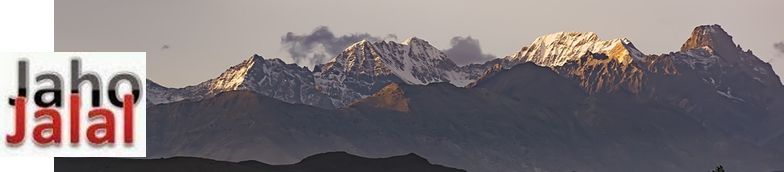
Showing posts with label Nanga Parbat. Show all posts

Wednesday, February 13, 2019

Pakistan: Your Travel Destination in 2019 - Forbes Tells


Pakistan offers startlingly striking scenery. Add to this the warm welcome of the people, the glacial blue of Atta-abad lake, the centuries of history, the juxtaposition of granite to greenery, the chance to walk through an age old-apricot orchard along water channels cut by hand, and the blazing snow-covered glory of Rakaposhi, and you must acknowledge there is a grand adventure to be had. - Forbes

And the claim is nothing but fully justified. Those who haven't seen Pakistan or staying away from it just because of some negative propaganda, mist listen to those who come here and do not want to go back - and even they go back, they come back again fro there is so much to bee seen of the untapped beauty that resides in the valleys guarded by towering snow capped mountains and welcomed by warm hospitable people.


Come visit the land of five of the Eight Thousanders,, the K2 (second highest peak after Mt Everest), Hunza, the beautiful place where people do not age, the mountain ranges of the Karakoram, the Himalaya and the Hindukush - all await you this year and tears after.

Watch the spectacular video about Pakistan's loveliest travel destinations:
Have you packed up your luggage to visit Pakistan already?

Photo | More Information and Destinations in Pakistan | 1 | 2 | 3 | 4 |
If you like Jaho Jalal, please follow us on Facebook

Sunday, January 6, 2019

Pakistan: Your Travel Destination in 2019 - Part II (The Heaven on Earth)

Tourists abound Switzerland each year to be closer to Nature in its purest form. But those who dare and venture into the scenic Northern Areas of Pakistan are spellbound to see another Heaven of Earth. While most of Pakistan's Northern Areas remain virgin, the much visited places leave the tourists spellbound for they may have never expected such natural beauty to have been there in Pakistan.

Pakistan is among those fortunate countries who have five peaks towering more than 8,000 metres, called the Eight Thousanders, including the mighty K-2, the second highest mountain of the world after the Mount Everest. But it is the most deadliest for the climbers as it is said that out of four climbers, one never returns. Scary, well yes, but the mountaineers from around the world still dare and come every year to scale this huge pyramid shaped mountain peak. Even K-2's famous base camp Concordia is a haven for the trekkers, though an adventure in itself.

We have lot to share as far northern areas of Pakistan. Some we have already shared and more leaves to be shared. There are places that takes days to reach on foot, but once there, one forgets about the hardships one has faced reaching there. Recently, there is a hike in youth of Pakistan venturing into the desolate mountains, crossing roaring rivers and walking on hair-raising mountain tracks where even a slip can cost one's life. But this does not deter the adventurers and each day a new area is explored, an unbeaten track walked on and rising and setting of sun watched in awesome lonesome landscape amid whistling sound of the winds, that sometime even rip through one's body leaving one chilled and numb.


The social media is abound in videos by tourists and foreigners coming to Pakistan and admiring the natural beauty of every part of the country, specially the northern areas of Pakistan. The rugged mountain tracks and inviting mountain peaks are a haven for trekkers and mountaineers.

This also reminds me of a series of posts I shared of Mary Loosemore, who along with a group of adventurers came to Pakistan some years ago and explored the Hindu Kush mountain range of Pakistan. Do read my blog by searching posts related to her adventure stories. Herein under is just one such video which leaves tourists spellbound of the awe inspiring landscapes, the very indigenous people and their warm hospitality.
This is just the second post of the series and we will add many more ind days to come to introduce to you the realities that are hidden from the outer world. Do give us your feedback if you have been to Pakistan or intend doing so in days to come.

Photo: Shangrila - Skardu, Pakistan | References: | Eight Thousanders of Pakistan  | 1 | 2 |
If you like Jaho Jalal, please follow us on Facebook

Wednesday, November 15, 2017

Fascinating Pakistan - The Eight Thousanders

Pakistan is one of those blessed countries which has enormous tourist attractions right from its 1200 long coast, mostly virgin, along the Arabian Sea, vast stretches of deserts, fertile lush green plains and snow clad mountain peaks dominating its north.

While the entire country is worth visiting and touring, it is a mountaineers haven as its has 108 peaks over 7,000 metres and as many over 6,000 metres, while there is no count for peaks over 5,000 and 4,000 meters. Most of the highest peaks in Pakistan lie in Karakoram Range (which lies almost entirely in the Gilgit-Baltistan region of Pakistan, and is considered to be a part of the greater Himalayan range) but some peaks above 7,000 m are included in the Himalayan and Hindu Kush ranges.

In fact Pakistan is the meeting point of three great mountain ranges, the Himalaya, the Karakorum and the Hindu Kush. And it is here in these mountain ranges lie five out of the fourteen eight thousanders (peaks over 8,000 meters) in the world. Of these five, four lie the Karakorum in the surroundings of Concordia; the confluence of Baltoro Glacier and Godwin Austen Glacier, while one is located in the Himalaya.


Herein under is the list of all the five eight thousanders located in Pakistan.
  • K-2 also known as the Chogori, Mt. Godwin Austen that reaches up to a height of 8,611 m and is the second highest peak of the world after the Mt Everest.
  • The Nanga Parbat (meaning the Naked Mountain) is 8,126 m high and is one of the deadliest of the eight-thousanders. This Himalayan peak ranks 5th in the 14 eight thousanders of the world. The summit is shaped like a reclining women, as remarked by some imaginative mountain and beauty lover. If flying to Skardu, one can see the Nanga from the right window of the aircraft. One can feel the grandeur of the height when flying almost to the level of its peak. Due to its difficulty in climbing, many mountaineers have lost their lives, that is why it is also known as the Killer Mountain.
  • Gasherbrum I (also known as Hidden Peak or K5) is the 11th highest peak on Earth, located on the Pakistan-China border in Gilgit-Baltistan region of Pakistan. Gasherbrum I is part of the Gasherbrum massif, located in the Karakorum region of the Himalaya.
  • Part of the Gasherbrum massif, the Broad Peak in the Karakorum Range is 8,051 m high and is the 12th of the eight-thousanders in the world. Broad Peak is known locally as Faichan Kangri and was originally referred to as K3. The summit is over 1.5 km long, from which it gets in name as the Broad Peak.
  • Gasherbrum II (also known as K4) is the 13th highest mountain on Earth, located in the Gilgit Baltistan province, Pakistan near the border to China at a height of 8,035 m (26,362 ft). Gasherbrum II is the third highest peak of the Gasherbrum massif, located in the Karakorum Range of the Himalaya.
I have already written about Nanga Parbat in one of my earlier posts on Fascinating Pakistan series. And would write about other four in my next posts.
Photo Credits: K2 Mobeen Mazhar  | Karakorum Peaks: Abbas Shah

If you like Jaho Jalal, please follow us on Facebook

Tuesday, November 14, 2017

Fascinating Pakistan - Fairy Meadows

The Nature has created replicas of heaven all around the world - but reaching these heavenly places is as arduous and extremely difficult as aspiring to be granted heaven in the world hereafter. The oasis in the deserts are reached after a man is at his breaking point after walking without food and water for days. Likewise in the obscured mountain valleys, there lie man a beautiful lush green places with lakes of crystal clear water, orchards laden with many types of sweetest fruits and overlooked by snow clad mountains. But to reach these, one has to really labour through treacherous mountain tracks, requiring extreme performance of 4WD jeeps or walking for hours over stony treks to finally reach these one-in-lifetime sites.
One of such heavens on earth is the Fairy Meadows in Diamer District, Gilgit-Baltistan, Pakistan. Located at an altitude of 3,300 metres, Fairy Meadows, which is called Joot in the local language was named "Fairy Tale Meadow or "Märchenwiese" by a German climbers on their way to scale Nanga Parbat. Fairy Meadows in fact is the gateway to the Nanga Parbat for trekkers attempting the Rakhiot face of Nanga Parbat. This heavenly grassland is located in the Raikhot valley, at one end of the Raikhot glacier which originates from the Nanga Parbat and feeds a stream that finally falls in the River Indus.
To approach Fairy Meadows, one can embark upon an 11 hours road journey to Chilas on the Karakorum Highway (KKH). From here at a distance of 61 kilometers is the Raikot bridge, where jeeps are readily available during the tourist season for six passengers per jeep. The road to Fairy Meadows then commences with a breathtaking twelve kilometers long jeepable track through a treacherous unstable gravel mountain pass, followed by yet another 3-4 hours of trekking on a five kilometers trek. In fact the drive is so dangerous that one is more worried about one's safety rather than enjoying the beautiful landscape one is passing through.


The jeepable track is considered as one of most dangerous roads in the world. The DangerousRoads describe the difficulty and extreme dangerous track in following words:

  • The road is an unforgettable experience. It’s winding, in some places only wide enough for one vehicle, and in many places bordered by a drop of hundreds of meters (many hundreds of feet) unprotected by guardrails. The most dangerous part of the road involves a narrow 6-mile ascend on an unpaved and uneven road. There are no barriers to prevent a vehicle from falling off the cliff to a fiery death.  The road is no wider than a standard Jeep Wrangler and there’s plenty of through traffic. One false move and it’s a very long drop.
  • The gravel road has not undergone any repair since it was built by the ethnic villagers of the Nanga Parbat Mountain hundreds of years ago which makes it one of the dangerous roads on this list. The road was built by the local people, and is therefore a private toll road. It’s steep and just the width of the jeep, with unstable gravel road hacked out of the barren hills.
  • Words can’t describe the road and pictures don’t do it justice.This drive is only recommended for the people who are serious mountain lovers and have strong nerves. This is a stunning place for photographers and nature lovers. But this road is definitely not for the faint of heart, so, if you want to go there - bring a lot of courage with you!
But once one reaches the lush green Fair Meadows, one instantly how one has reached this heaven on earth. Words alone cannot describe the beauty of the place, with fresh breeze blowing and a landscape so captivating that soothes one eyes which just moments ago were seeing nothing but barren stony mountains over a life threatening unkempt gravel track.
The Fairy Meadows grassland is surrounded by thick alpine forest. The high altitude area and north-facing slopes mostly consist of coniferous forest having Pinus wallichiana, Picea smithiana and Abies pindrow trees, while in the high altitude areas with little sunlight are birch and willow dwarf shrubs. The southern slopes are concentrated with juniper and scrubs, namely Juniperus excelsa and J. turkesticana. In the low altitudes, the major plant found is Artemisia, with yellow ash, stone oaks and Pinus gerardiana spread among it.
A spectacular view of Nanga Parbat from Fairy Meadows

From here one can have a spectacular view of the majestic Nanga Parbat, one of the 14 eight thousanders of the world and one of the five eight thousanders located in Pakistan. Read more about Nanga Parbat in one of early posts on Fascinating Pakistan series. 

Sitting on the slopes of Fairy Meadows and looking at the Nanga Parbat, one feels as if one is sitting in a lush green bowl being overlooked by the awe inspiring mountain in the backdrop. One can listen to many folklores about the area and of the many expeditions that passed through to scale the Nanga Parbat and the sadness in their tone when describing dead bodies of climbers being taken away who fell victim to the Killer Mountain, the Nanga Parbat.

I would now stop my commentary and let you watch the video below that explains everything and shows you from roads to jeepable tracks and finally horse back to Fairy Meadows, overlooked by the mighty Nanga Parbat or the killer mountain in the background.
The six-month tourist season at Fairy Meadows starts in April and continues until the end of September. Tourists lodge at the camping site spread over two acres, known as "Raikot Serai" and the other at Fairy Meadows, though partially developed.

I am sure the video above gives you a fair idea of the challenges to be faced while driving on the mountain track and then finally reaching the Fairy Meadows - Next time you visit Pakistan, do consult your travel agent to include Fairy Meadows as one of your travel destinations for life time adventure.

Photos Credit: Northern Areas of Pakistan | References: Wikipedia
If you like Jaho Jalal, please follow us on Facebook

Friday, November 10, 2017

Fascinating Pakistan - Nanga Parbat


I have been writing about the beautiful and awesome travel destinations of Pakistan and the world over in my blog since long. I have traveled to many countries and was awe stricken by the natural beauty everywhere that I went and traveled to. But looking back, Pakistan has much more for the world to know about and explore the maiden and in some cases still generally unexplored landscape which have no parallel in the world.

So I have decided to start a series of posts to show to the world the fascinating face of Pakistan. And to start with, I have chosen Nanga Parbat - a massive eight thousander out of the 14 above 8,000 meters high mountain peaks of the world. It is the 9th eight thousander on the world table and second as far Pakistan is concerned after the K-2, the second highest after the Mt Everest.

You may ask why I chose Nanga Parbat and not K-2? well Nanga Parbat has special fascination for me as once flying to Skardu in a PIA's Fokker friendship, we flew past this massive massif and its landscape is still vividly preserved in my memory.

Standing as tall as 8,126 metres (26,660 feet) above mean sea level, It is the only eight thousander of Pakistan located out of the Karakorum mountain range in the Himalayas. In fact, it is the western anchor of the Himalayas around which the Indus river skirts into the plains of Pakistan. Nanga Parbat along with Namcha Barwa on the Tibetan Plateau mark the west and east ends of the Himalayas. It is located approx 27 km west-southwest of Astore district, in the Gilgit–Baltistan region of Pakistan


Like K2, which more difficult to climb than the Mt Everest, Nanga Parbat too is also notorious for its difficult climb and many mountaineers have lost their lives trying to scale Nanga Parbat, or the Killer Mountain as it is known after so many aborted attempts and deathly incidents. It is the vertical relief of the mountain that makes it difficult for the mountaineers to scale it.

Another view of Nanga Parbat shared with courtesy of Nawab Tanweer Ahmad (Facebook)

Nanga Parbat was first  attempted in 1895 by a European expedition under Albert F. Mummery. They climbed to height of 6,100 m (20,000 ft) on the Diamir (West) Face, but Mummery and two Gurkha companions later died reconnoitering the Rakhiot Face. Since then, many expeditions, mostly from Germany, attempted to scale this formidable mountain but failed with caualties.

It was finally successfully scaled on July 3, 1953 by a German-Austrian expedition an its Austrian member  Hermann Buhl had the honour to stand atop Nanga Parbat for the first time. However, all attempts were made in the summers in rather fair weather. It was as late as February 26, 2016 that Nanga Parbat was scaled in sheer winters by  Ali Sadpara of Pakistan and Alex Txikon from Italy and Simone Moro from Spain.

Watch a awesome video of Nanga Parbat below:
Nanga Parbat is one of only two peaks on Earth that rank in the top twenty of both the highest mountains in the world, and the most prominent peaks in the world, ranking ninth and fourteenth respectively. The other is Mount Everest, which is first on both lists. It is also the second most prominent peak of the Himalayas, after Mount Everest. The key col for Nanga Parbat is Zoji La in Kashmir, which connects it to higher peaks in the remaining Himalaya-Karakoram range.

This, despite its difficulty in climbing, Nanga Parbat remains as one of the favourite scaling site among the mountaineers around the world and almost the entire year, expeditions keep coming to Pakistan to challenge its invincibility and claim its summit in their log books.

References: Wikipedia | Photo courtesy Northern Areas of Pakistan (Facebook)
If you like Jaho Jalal, please follow us on Facebook

Thursday, December 16, 2010

Valleys of Pakistan

Pakistan is a tourists’ paradise. It has everything one would dream and wish to see. Rather I would say that Pakistan abounds in so many places one would wish to see before dying. In fact every inch of Pakistan is worth visiting as every stone and corner carries in itself history of thousands of years. From sea shore to snow capped mountains, there are deserts and lush green plains to travel.


For those seeking a break from the hustle and bustle of traffic and noisy city life, the northern areas of Pakistan are the ideal tourist havens. In fact the northern areas of Pakistan are replica of heaven on earth. The towering snow capped mountains surround some of the spectacular, scenic and breathtaking valleys of the world. One really wonders off when travelling and touring through these valleys and is momentarily lost amid serene and picturesque landscape.


The mountain ranges of Hindu Kush, Karakoram and Himalayas have some of the awe inspiring valleys nested in between their majestic mountains. The valleys are also home to some of the wonders of the world. Lake Saiful Mulook, peacefully lying at the foothills of Malika Parbat (Queen of Mountains) at an altitude of 12,000 feet is a jewel in crown of the Kaghan Valley. The Gilgit Valley is home to the mighty Nanga Parbat and Raka Poshi mountains and allows access to the Hunza Valley – the lost Shangri-La.


It would be unjust to describe the beauty of the valleys of Pakistan in a few lines. In my coming posts, I will make and endeavour to describe these valleys separately, highlighting their uniqueness and serenity.


Related Reading: Valleys of Pakistan (Pakistanpaedia)

Thursday, January 14, 2010

Nanga Parbat (the Killer Mountain) – Winning Hearts in Germany

Nanga Parbat, meaning the Naked Mountain in native language, the 8,125 Metres or 26,657 feet tall Himalayan peak, is also known as Diamir (King of Mountains) in local language. It faces the Nanga Parbat Lake in front of Fairy Meadows which gets its name from the local folk who consider Mountains to be the abode of fairies. Nanga Parbat is the ninth highest mountain in the world, and the westernmost mountain of the Himalayas.

The summit is shaped like reclining women, as remarked by some imaginative mountain and beauty lover. If flying to Skardu, one can see the Nanga from the right window of the aircraft. One can feel the grandeur of the height when flying almost to the level of its peak. I once flew to Skardu and was mesmerized by the glory and majesty of this great mountain which almost leveled off by the plane window. 

Nanga Parbat, located at the western end of the Himalayas, was first conquered by Herman Buhl, of Germany, in 1953 after 31 people died attempting it. Since then more have died on its slopes but mountaineers all over the world would still like to conquer this otherwise technically one of the most difficult mountains to climb.


Recently, German audiences are getting mesmerized by a real story that took place at Nanga Parbat, and of enduring human spirit revealed by two German brother mountaineers. The film is getting screened in 300 cinemas in Germany. The film dramatized the thrilling, emotional and tragic events of the expedition to Nanga Parbat in 1970 and concentrates on the young and ambitious brothers Reinhold (25 years) and Gunther Messner (23 years) on their way to first over eight thousand meter high mountain. 

Its route leading up to 4500 meters called Rupal Wall, is the world’s highest steep face and is considered most challenging mountaineering in the world. The film beautifully depicts the risks and difficulties that the expedition had to face while climbing this route, said a message received from Berlin. The premier of the film was attended by German Chancellor Angela Merkel at Delphi Filmplast, Berlin. Leading politicians, diplomats, artists and celebrities were also present at the opening show.

Related Reading:
If you like Jaho Jalal, please follow us on Facebook