Showing posts with label History. Show all posts

Sunday, December 11, 2022

Morocco in FIFA world Cup Semis - History in the making

Ever felt privileged to be part of history in the making? Yesterday I felt being that privileged one "watching" history in the making. The quarter final match between Portugal and Morocco was the venue of this historical event being penned down in the history. 

Noone could image that an African country, and a Muslim country, ever to make it to the semis of the FIFA World Cup Soccer? Well, it was yesterday that all myths were broken. The 1:0 win be favorites Portugal in the quarters led them to the semis - a great feat for the Moroccans and the Africans.

Ass per FIFA, "What a journey it has been. Group F had been widely viewed as Qatar 2022's toughest, containing as it did the teams that finished second and third at the last FIFA World Cup."  The lone goal in the later part of the first half was a maestro. And thereafter even calling ‏Cristiano Ronaldo in the early second half could not turn the sides and Morocons finished semifinalists. Wow


Watch the highlights of this memorable historic FIFA match ever:
Let us now wait and see whether the resilient Moroccans continue to make history till the final of the FIFA World Cup soccer at Qatar 2022. 
Photo | References | 1 |
If you like Jaho Jalal, please follow us on Facebook

Tuesday, November 10, 2015

A visit to Iqbal Manzil - the birthplace of Allama Iqbal


Sialkot, besides being famous for sports goods of international standard including footballs for World Cup, is also the birthplace of Dr Allama Muhammad Iqbal - a poet philosopher and national poet of Pakistan. It was he who in the early 20th century thought of a separate Muslim country to be carved out of the British India and later entrusted the sacred task to Muhammad Ali Jinnah, who completed Iqbal's dream with the creation of Pakistan on 14 August 1947 as the vast British Indian Empire came to an end.

A few years back I visited Sialkot and met a friend who insisted that I must visit the Iqbal Manzil - the birthplace of Iqbal. But the time was almost midnight and I wondered how would he be able to show us this important and historical landmark of Pakistan. He had it done with a phone call to Mr S Riaz Hussain Naqvi, who is the curator since 1986, and Mr Naqvi obliged us by opening the building, awaking from his sleep, and conducted our tour of the building and various artifacts placed there.


We were told that the building was bought by Sheikh Muhammad Rafiq, Iqbal's grandfather, in February 1861. At that time the house consisted of only three rooms, which have now been converted into a museum. In December 1892, Sheikh Noor Muhammad, Iqbal's father, bought the adjacent house which now forms part of the Iqbal Manzil complex. It was here that Iqbal was born on 9th of November 1877.

After the death of his father, Iqbal's elder brother, Atta Mohammad became the owner of the house. However, after the death of Atta Mohammed, his two sons took up residences in Karachi and Lahore. The Government of Pakistan bought Iqbal Manzil for its restoration in 1971 and handed it over to the Archaeology Department, who aptly accorded it the status of a cultural heritage. After some renovation, Iqbal Manzil was converted into a library-cum-museum. The museum was inaugurated in 1977.The museum consists of a guided tour of some rooms of the mansion, and displays some furniture and other objects used by Allama Iqbal.

 The room where Iqbal was born on 9 November 1877
 The 'pram' used by newly born Iqbal
 Mr Naqvi showing us an old door leading out in the street

 Iqbal's portraits - in the photo on right Ibal is seen holding his son Javed Iqbal
A group photo of Iqbal at the Government College, Lahore (where he studied and later taught as a professor)


Moving up on the first floor on the stairs shown below, we had the opportunity to see the living and dinning rooms of the building.


Iqbal's bed and Hookah he is most often seen in photos like the one below

 The dinning room (above) and the lone surviving plate with a hole to pour hot water to keep the food hot


 The dilapidated cupboard storing some of the personal books of Iqbal
The wooden box for storing utensils - I still have a box like this
 The still functional roof fan
Mr S Riaz Hussain Naqvi - the curator of Iqbal Manzil

Mr Navi since taking charge has been intimately involved in the restoration and rebuilding of this crumbling historic building. But despite his sincere efforts, the building is in poor state of maintenance. Cracks appeared several years ago in almost all the walls of the building. 

The Sialkot district government has repaired the cracked walls of 147-year-old Iqbal Manzil. Now the walls have been repaired and whitewashed, and the second storey of the three-storeyed building has been carpeted. A room of Iqbal Manzil houses a more than 4,000 old books, among them 2,000 are on Iqbaliyat. 

It is planned to build a large library by collecting books, both on and by Iqbal, from all over the world where research could being conducted on the poet and his works. This library has already facilitated 5 students to attain their PhD degree on the works of Iqbal.

However, despite many claims and assurances by the government, the building remains neglected and does not look like a place attributed to a person like Iqbal whom we owe our freedom and present day Pakistan.

Photos Credit: All photos except the head photo of the building have been taken by me - and have also been shared in my website on Pakistan: Pakistanpaedia

Read more about Dr Allama Muhammad Iqbal in my post: Iqbal Day - a dreamer's birthday

If you like Jaho Jalal, please follow us on Facebook

Saturday, August 3, 2013

The sinking of HMS Rawalpindi

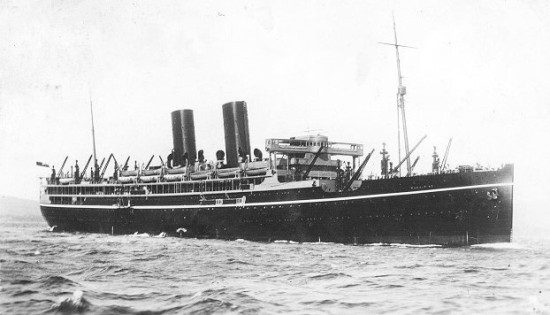
Armed Merchant Cruiser HMS Rawalpindi [Photo: Uboat]

Many natives of Rawalpindi city of Pakistan wouldn't know that there was once a passenger ship called HMS Rawalpindi. The same way many natives of Sahiwal wouldn't know that a ship called Sahiwal Express once sailed in Australia. And I wonder if many know why Sahiwal is known as Sahiwal and why Australia named a ship after this city of Central Punjab in Pakistan.

Those who do not know why Sahiwal is known as Sahiwal may read my earlier post 'Cow and the City.'

But for now lets us talk of HMS Rawalpindi and how did it sink. 

HMS Rawalpindi was a passenger ship launched on 26 March 1926, built by Harland & Wolff Ltd. (Greenock, Scotland). However during the WW-II, when the British Navy was in desperate need to expand its navy to counter the superior German Navy, the passenger ship Rawalpindi of the P. & O. Steam Navigation Co Ltd, London was requisitioned by the Admiralty and converted to an armed merchant cruiser on 26 August 1939. Conversion was completed on 19 September 1939 by the addition of eight elderly 6 in (150 mm) guns and two 3 in (76 mm) guns.

HMS Rawalpindi, now an armed merchant cruiser, was tasked to patrol  the Northern Patrol covering the area around Iceland in October 1939. On 19 October in the Denmark Strait, Rawalpindi intercepted the German tanker Gonnzenheim. The tanker was scuttled by her crew before a boarding party could get on board.


Then came the fateful day in the life of HMS Rawalpindi when it was patrolling north of the Faroe Islands on 23 November 1939. She was intercepted by two powerful German warships the battleships Scharnhorst and Gneisenau. Being a merchant / passenger ship by design,  she was simply out gunned  But her captain  Edward Coverley Kennedy decided to to fight rather than surrendering to the Germans.  He was heard to say "We’ll fight them both, they’ll sink us, and that will be that. Good-bye".

And that was the last of HMS Rawalpindi that was heard back.  238 men died, including Captain Kennedy as the ship sank. Thirty-seven men were rescued by the German ships, and a further 11 were picked up by HMS Chitral (another converted passenger ship).

This bring to forth another ship HMS Chitral, about which I will write sometime later.

For detailed eye witness account of the sinking of HMS Rawalpindi, please read:
My Night to Remember- The Sinking of the HMS Rawalpindi
We manned the guns of the HMS Rawalpindi
Reference: Wikipedia | Uboat |

If you like Jaho Jalal, please follow us on Facebook

Sunday, January 13, 2013

Hanjarwal - A place hidden in obscurity

It was long time back that I met a acquaintance of mine who whose name ended with 'Hanjarwal.' Upon inquiry about this strange word, he told me that it was the name of place from he belonged to. And that was the end of Hanjarwal for me.

Today I came across a post in my friend SAJ Shirazi's blog that was about Hanjarwal and I stopped right there and read about the place I had long ago heard of. I found the narration by Salman Rashid, one of the best travelogue writers of Pakistan and am sharing the post for all those who too have heard the name but never tried to know more about Hanjarwal like I did.

Here it is all about Hanjarwal - Lost from the View, Really


From very ancient times, this land was traversed by roads, roads and roads. There were arterial highways like the Rajapatha that connected Bengal with the Afghan highlands. We hear of it from the chronicles of the 4th century BCE and know that this was the very road that we eventually came to know as the Grand Trunk Road. There were others that stretched between important cities.

One such was the highway connecting Lahore and Multan that we today call National Highway 5 (N-5). Though this highroad had existed ever since time began, in the Middle Ages its importance grew when the peaceful years of the Mughal Empire spurred all-round growth. While Lahore in the north became a much favoured city as an alternate Mughal capital, Multan once again thrived as a rich centre of trade and commerce. It was one of the richer subas (provinces) of the empire during the reign of the third Mughal king, Akbar the Great.

To facilitate the passage of trade and travel, the old road connecting Multan and Lahore received a good deal of attention. Among other road furniture, new caravanserais were built where existing ones were falling to pieces. Now, distance between serais was dictated by the day’s travel which in those times was between twenty-five to thirty kilometres. Thus leaving the walled city of Lahore the first serai on Multan Road was at Hanjarwal. A victim of unplanned growth, this serai has long since disappeared.

Lost from view, overgrown with the ugly warts of unplanned rural architecture, Serai Chhimba sits amid blocks of agricultural land some thirty kilometres south of Hanjarwal. Lying a kilometre west of N-5, Serai Chhimba marks the alignment of the old road from the Middle Ages.

We know of Begum ki Serai adjacent to Attock Fort; Serai Kharbuza, midway between Taxila and Rawalpindi; Rewat, east of Rawalpindi and Rajo Pind just outside Rohtas Fort that are all believed to be fortresses. In truth, these are serais, fortified so that they could be locked up for the night to hold robbers at bay. Indeed, this was no deviation, but standard serai architecture all across Central Asia, Iran and the Indian subcontinent.


So too was Serai Chhimba built like a fort with massive walls and two gateways, one each in the direction of the rising and setting sun. In the interior, along the perimeter walls, was a series of sunken rooms with domed ceilings and thick walls to keep out the heat and cold. These were the residential rooms for passing travelers while their pack and riding animals were tethered in the broad enceinte.

The gatehouses on both sides are massive and have bulky arched openings which, going by their style, are clearly Akbari. While the western gatehouse is now occupied and turned into a residence, the one in the east serves as the only way in and out. Until a few years ago the timber leaves of the gatehouse were still in situ, but with the rise in street level, they became unserviceable and one day disappeared. Local gossip has it that the expensive teak was appropriated and sold by the keeper of the spurious shrine inside the serai. So much for those who pretend to be descendants of a worldly man turned holy postmortem by the accretion of yarns.


While the gatehouses mark east and west, the other two cardinal points are scored by massive vaulted structures. These and the gatehouses are each topped by two square towers rising to ribbed domes starkly reminiscent of Samarqand and Herat. None of them retains any of the coloured tiles that may have once adorned them. To emphasise its defensive strength, each corner of the serai has an octagonal turret.

The compound where travellers once tethered their animals is now choc-a-bloc with haphazardly placed houses bisected by streets. Houses along the perimeter wall incorporate the sunken rooms of the serai into their design: as bedrooms these are cool in summer and warm in winter. Everywhere there are signs of disturbance to the original structure of the serai in order to add rooms.


Only a few days before my visit in mid-February, the owner of the house adjacent to the east gate had pulled down one of the two domed towers in order to add a room on his roof. The debris of ancient Mughal bricks and lime mortar had still not been removed. It was his home and he felt he could do whatever he pleased with it – the historic monument be damned. Indeed, the two similar structures on the south wall had gaping holes: used as rooftop kitchens, the openings in the roofs served as chimneys. In the north wall only one of these towers remains. Inmates do not know what became of its companion but they have broken a large opening in it and use it as storage for cow dung patties. Its exterior serves as the post where the patties are dried.

Sometime after the advent of train and motor transport Serai Chhimba fell out of use as a way station. During the Raj when people were more than aware of the presence of the government, this historical inn would not have been appropriated for private residence. With independence two things happened. First, in the hands of incompetent politicians, the new state of Pakistan began to cede authority from the very first day. Secondly, in the absence of any settlement policy, the huge influx of refugees pouring in from across the newly-drawn border took over whatever they found handy.

Serai Chhimba, built about 1580 and therefore a protected historical monument, fell victim to this takeover riot. For some years after partition, it may have retained its serai atmosphere, but galloping population growth quickly smothered it with ugly and unplanned housing. For these refugees from Karnal and Rohtak, this is apparently still not home. They have no feeling for the land, its culture and its history. It is something to be appropriated and destroyed. Sadly, this is no aberration; this is the norm in this blighted land.

Looking at the whole lot of Pakistani people, this utter disregard for our own heritage is our only unifying national trait. Surely this must be the only country in the entire world where a citizen can destroy any historical building without fear of persecution. We see it happening in cities like Lahore, Bhera, Shikarpur, you name it. It is happening in Serai Chhimba as it happened at Hanjarwal where no more than part of the serai gateway now stands. Only some miles away to the east of Serai Chhimba, Dera Chaubara, another 16th century monument and exquisitely beautiful too, has been laid waste by treasure hunters (Herald April 2003). This same breed of ignorant philistine is destroying the hilltop monastery of Tilla Jogian in Jhelum district. This list is endless.


In another country where the writ of the state exists, such wanton destruction of the national heritage would cause uproar. Heads would roll, especially of those entrusted with the upkeep of national monuments. But in Pakistan we let things be. In another few decades, monuments that should have drawn ordinary tourists and students of history and medieval architecture to this land will be no more than heaps of rubble. And not because of age and natural causes, but because of our national indifference for our own heritage.

About the Author: Salman Rashid, Fellow of Royal Geographical Society, is author of eight books including Jhelum: City of the Vitasta and The Apricot Road to Yarkand.

If you like Jaho Jalal, please follow us on Facebook
Wednesday, August 8, 2012

Lahore's Town Hall - the last Landmark on The Mall

The Shahrahe Quaid-e-Azam, or the famous Mall Road of Lahore is studded with Victorian style buildings almost throughout its length. Starting from the Mian Mir Cantonment Bridge, the first one to appear is the Aitchison College on the right and then it continues till it ends near the building of the General Post Office Lahore.

The Town Hall, Lahore - 1890 [Photo courtesy Tahir Iqbal / Flickr ]
The major portion comes from the Lahore High Curt building, followed by the GPO, Tollington Market, Lahore Museum, the Punjab University, the National College of Arts and finally the Town Hall building. All buildings are unique in their Victorian architecture, specially the Town Hall building. It is this last building, that this post is about.

I saw this monumental building right from my younger age as the Double Decker buses of the Lahore Omnibus Service which I traveled on from my home to my school and later the Government College, turned right in front of the Town Hall building and this used to be the last glimpse of the Mall and buildings on it.

Lahore Town Hall
A beautiful painting by an unknown artist of Town Hall, Lahore in a pre-partition mood set displayed in Garrison Mess, Lahore ( I shot this with my cell phone camera while staying in the mess)

The building is presently under use by main government offices of the City District Government Lahore (CDGL) and Fire Brigade.

Town Hall building with two flags [Photo courtesy: Global Clock Time]

The importance of the Town Hall multiplied manifold after the 1965 Indo-Pak war. The Indian thrust of attack was two pronged aimed at the cities of Lahore and Sialkot. The people of the two cities fought side by side their brethren in uniform and supported the armed forces in every way they could. It was their support that enabled Pakistan Army from letting the Indian Army realize its aims and objectives and halted their forces far away from Lahore. 

Postage stamp showing the special Pakistan flag 'Hilal-e-Istaqlal' issued May 15, 1967
For the resilience shown by the people of Lahore and the support afforded to the armed forces, the government of Pakistan announced special flags, known as Hilal-e-Istaqlal, to the people of Lahore, Sialkot and Sargodha (Sargodha is a major Pakistan air force base from where successful air missions were flown both inside and outside Pakistan in support of the ground forces).

Citation for Lahore on the eve of award of Hilal-e-Istaqlal reads:
In the early hours of Monday, the 6th September, 1965, the enemy launched his treacherous attack without declaring war and advanced towards LAHORE from three directions. The enemy’s advance was stopped dead near the border on the very first day of the battle by our gallant Army, but he went on trying for a break-through until the end, which he could never achieve against the steel wall of our heroic forces. Throughout this period the enemy planes raided Lahore; and the outskirts of the city were subjected to shelling day and night. This bomb-ing and shelling of unarmed civil population brought death to many, including women and children. The enemy exercised intense savagery with complete lack of scruples. But the people of Lahore remained undaunted and unperturbed and faced the challenge with cool and un-waver-ing determination. People of all walks of life stuck to their jobs and went about their normal business without any signs of tension. They forgot all their incon-veniences and tried to help the country’s war effort to the best of their ability. Every day in their thousands they stood on the roads leading to the front. Every day hundreds of them headed towards the front line to join their gallant soldiers fighting the enemy and had to be restrained with great difficulty. The attitude of the people of Lahore during this period raised the already high morale of our troops to new heights and they answered their call by not only preventing the treacherous enemy from coming anywhere near their town but also by throwing him back and pursuing him into his own territory. Throughout this period the people of Lahore displayed their traditional cour-age and defeated the evil designs of the enemy to demoralize them. Their determination and devotion to the country will be re-called with pride by the generations to come. It will become an epic of our history that the enemy attacked “the heart of Pakistan”, for that is how Quaid-i-Azam described Lahore, but failed to hurt it; “the heart” throbbed on with health and vigor.

Hilal-e-Istaqlal [right] at Town Hall, Lahore
Now the Hilal-e-Istaqlal flies side by side the flag of Pakistan at the Town Hall building since the day it was first conferred upon the citizens of Lahore and is replaced every year on September 6, the day of the commencement of the war, now celebrated as the Defence Day each year.

Saturday, July 21, 2012

Monday, April 30, 2012

Travel Pakistan to walk into the history of Ancient Civilizations

There are very few countries in the world which have seen the dawn and death of great civilizations since  7000 BC when the greater Egyptian civilization was at its peak. And certainly Pakistan is one of those history rich countries, which have roots embeded in the history so majestically that only those visiting the ruins can feel the grandeur of the people who once inhibited this part of the world.

It is for this reason that Pakistan is known as the melting pot of cultures and civilizations. 

The Mehrgarh and Indus Valley Civilizations, the Gandhara, Arabs, Afghans, Mongols, Moguls, Persians, Turks and finally the British besides the indigenous customs and traditions have had a profound effect on the culture and traditions of Pakistan. The climatic conditions and different geographical regions from sea cost to deserts, plains to snow clad mountains have further magnified our culture. 

An onlooker would therefore find varying architecture, languages, dress and food as one moves from south to north, or from east to west. 

Mehrgarh civilization in the foot hills of Bolan Pass and arid Kachi plain of Balochistan province of Pakistan is the the earliest known farming settlement in South Asia, which once thrived around 7000 BC until the end of Indus valley civilization. Neolithic Mehrgarh consists of four mounds. The remains show that around 5100 BC, the Mehrgarh inhabitants constructed mud-brick structures. The remains of a large town spread over some 170 acres makes it the largest in the ancient world, being five times the size of the contemporary Catal Huyuk site in Turkey which has been called the largest Neolithic site in the Near East. It may be added that the entire population of Egypt was around 30,000 persons around 6000 BC, almost same as of Mehrgarh alone. 


Many believe that Indus Valley civilization has been the oldest civilization that flourished in the Indian subcontinent. Mehrgarh Civilization, though broke this myth, there were yet other surprises. The excavations at Kot Diji, Sind Pakistan has revealed that before Indus Valley, there existed a civilization that is pre-Harappa and Harappa period occupations (ca. 3200-2000 BC).  A forty-feet high archaeological site reflects the grandeur of the past and craftsmanship of those people. Historians and archaeologists are of the opinion that Indus Valley Civilization borrowed or developed some of the basic elements of life and culture from the civilization that was thriving at Kot Diji.


The later period of Indus Valley civilization from 2400-1800 BC, there is marked improvement in system of weights and measures, identical sized fire-backed bricks and standard writing system. So far about 700 sites have been discovered relating to the Indus Valley. Harappa, Mohenjo-Daro, and Ganweiwala are the larger sites of all spread over some 120 hectares and constructed like a citadel with separate public and residential areas, interspersed with road network. Extensive sewage and water drainage systems also are unique to Indus settlements.


Gandhara and Buddhism are two civilizations that thrived in the northern parts of Pakistan from around the Vedic times and Greco-Buddhism is considered to be the cultural syncretism between the culture of Classical Greece and Buddhism, which developed over a period of close to 800 years in the area corresponding to modern-day Afghanistan and Pakistan, between the 4th century BCE and the 5th century CE. Greco-Buddhism influenced the artistic (and, possibly, conceptual) development of Buddhism, before it was adopted by Central and Northeastern Asia from the 1st century CE, ultimately spreading to China, Korea and Japan.


And before I forget to mention of a people who have yet to find a credible linkage to their ancestors so far - the Kafir "Kalash: Who are these people, no one knows for sure. There are many theories - the most popular being the one that take these people to the Alexander of Macedonia: The Persian emperor Cyrus the Great conquered part of the Punjab somewhere around 530 BC, while Alexander the Great conquered area up to Multan before his own troops forced him to turn back in 332 BC. Some believe that the "Kafir Kalash" tribe in northern areas of Pakistan (Chitral) are the decendants of those Greek soldiers who married the locals and left their imprints behind. The "Kalash Country" is spread over three Valleys; Bomboret, Birir and Rumbur in the remote mountains of Chitral in the northern mountains of Pakistan.  


Read more about the civilizations that once thrived in the areas of the present day Pakistan, specially the Kalash people who live in  a world of their own obscured behind high mountains.


Related / Reference: Pakistanpaedia
The dawn of civilizations
Kalash Valley - Where Fairies Dance and Sing

Thursday, December 22, 2011

Sikh Era Relics in Lahore Museum

The Sikhs, after the demise of the Mughal Empire in the united India, ruled almost the entire India from 1799 to 1849. It was forged, on the foundations of the Khalsa, under the leadership of Maharaja  At its peak, in the 19th century, the empire extended from the Khyber Pass in the west, to Kashmir in the north, to Sindh in the south, and Tibet in the east.

The death of the death of Emperor Aurangzeb of the Mughal Empire provided opportunities for the Sikh army, to lead expeditions against the Mughals and Afghans.

The formal start of the Sikh Empire began under Ranjit Singh, who was crowned on 12 April 1801 creating a unified political state. Ranjit Singh rose to power in a very short period, from a leader of a single Sikh Misl to finally becoming the Maharaja of Punjab. He began to modernize his army, using the latest training as well as weapons and artillery. After the death of Ranjit Singh, the empire was weakened by internal divisions and political mismanagement. Finally, by 1849 the state was dissolved after their defeat in the Anglo-Sikh wars.

Lahore Museum is rich in relics of Sikh Era. Tahir Iqbal, who has carried out lot of research on the Sikh history, provides us photographs of the Sikh Era relics, which are preserved in the Sikh Gallery of the Lahore Museum. Herein under are some of the snap shots of arms and other objects which have been in the Sikhs use in Punjab.
The majestic Victorian style building of Lahore Museum located on The Mall, adjacent to National College of Arts and Tollington Market
 Coin of Ranjit Singh's times
Medal for Army of Sutlej - 1845

Inkpot bombs, 1916 - These brass inkpot bombs were recovered by police from Lahore. They were meant to keep on Judges table and designed so as to trigger the explosion as soon as the lid was opened.

Marble Hands (Said to be representing those of Rani Jindan)
Lock Of Sikh Period at Lahore Museum (Made By Ram Ji Das Mastri Resident of Meni Mazara District Ambala)
Wooden chair and table studded with marble used by Ranjit Singh
Gun Powder Flashes – 18-19th Century AD
Swords / daggers of Mughal and Sikh period
Blade of Ranjit Singh's War Axe
 
Swords of various sizes used by Sikhs
Watch of Bhagat Singh
Resource for Sikh History: Wikipedia
Photographs: Tahir Iqbal (Flickr)
If you like Jaho Jalal, please follow us on Facebook

Tuesday, November 1, 2011

Travel Pakistan: Fort Oblivion

Full Story shared at Logic is Variable by Syed Asghar Javed Shirazi

Ramkot Fort across the Mangla Lake
Fort Oblivion - the name sounds strange, but it goes very well with the actual fort located in wilderness across Mangla Lake. Ramkot Fort, forgotten by time and human beings since the construction of Mangla Dam, was once part of an important triangle of three forts: Ramkot Fort, Mangla Fort and Rohtas Fort. While the latter two still attract visitors, being close to roads, Ramkot Fort due to its inaccessibility is only found in history books.

To go to Ramkot Fort, one may have to request for speed boats of Mangla Army Sports Cub, as the fort is located on the far bank of Mangla Lake if viewed from the Mangla Fort. One may not venture going out in a rowing boat , which may take the entire day to reach this desolate fort, which is now only visited by avid travelers and historians. Otherwise bats abode the fort during day and fly over the fort giving it a Draculaen look.

Salman Rashid, author of Fort Oblivion,  describes travel to Ramkot Fort in following beautiful words:
"A solitary shoveller, alarmed byour fast approaching speed-boat, scudded the still blue waters of Mangla Reservoir on strong, fast wings with my gaze tied to its tail. And even as wegained on it, it was clear of the water and winging swiftly away from us ingraceful flight. I, the conservationist, could even feel the surge of the bird’s adrenalin extend itself to my body as I marvelled at the sheer beauty and power of its take-off and the elegance of its flight angling off to the right."
Read Full Story of Fort Oblivion - by Salman Rashid, shared at Logic is Variable by Syed Asghar Javed Shirazi